
A reference guide to freeze-dried peptide material
Lyophilized peptides: freeze-drying and the dry powder.
Synthetic peptides are commonly supplied as a lyophilized, or freeze-dried, solid. This guide explains how freeze-drying works, why a dry powder changes more slowly than a solution, what the solid in a vial can and cannot tell you, and how to handle it so that the amount you weigh or dissolve for a laboratory stock solution is the amount you think it is.
For laboratory research use only. Not for human or veterinary use.
In this guide
How does freeze-drying turn a solution into a dry solid?
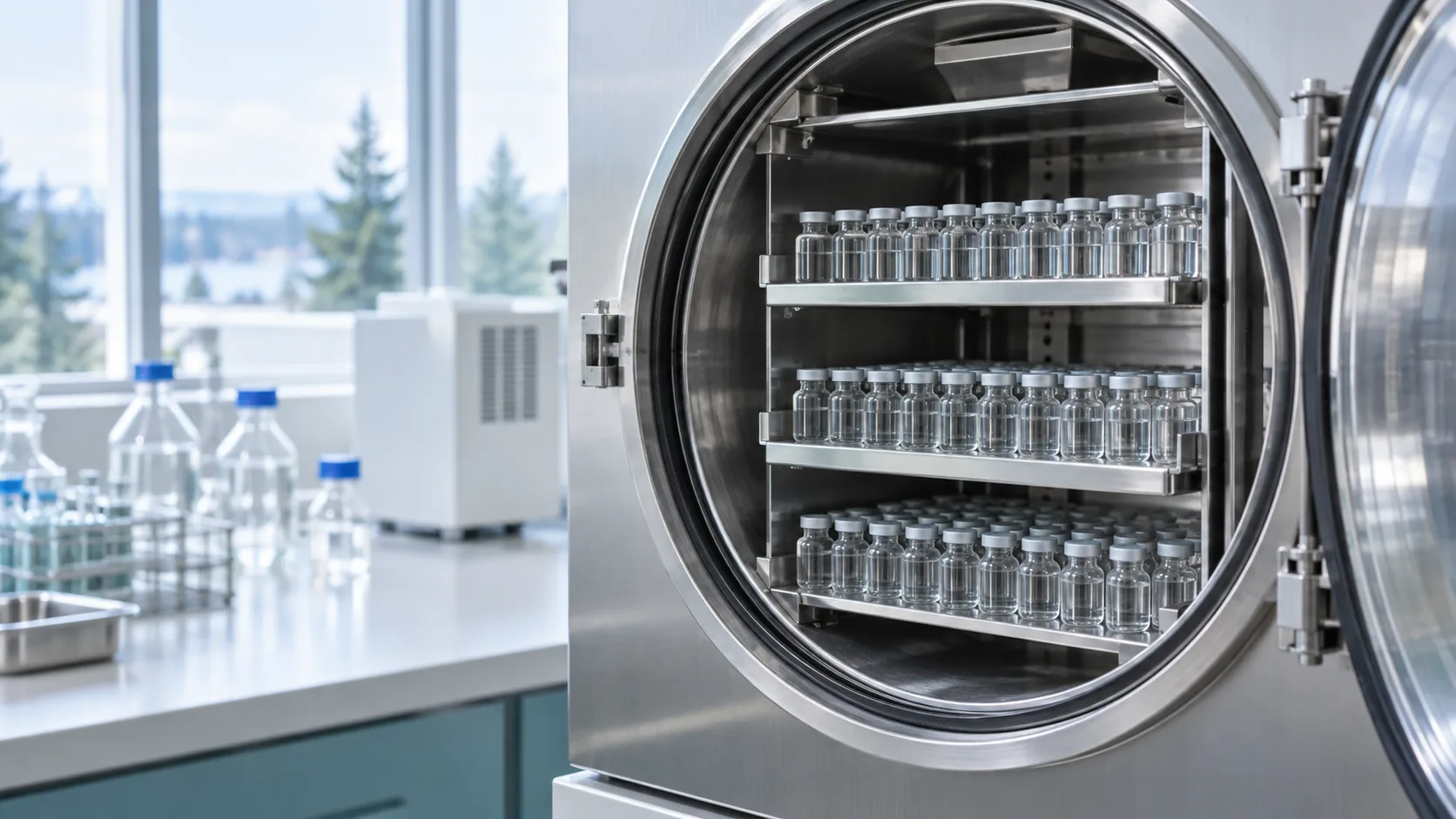
Freeze-drying, also called lyophilization, removes water from a frozen solution. A freeze-drying cycle has three stages: freezing, primary drying and secondary drying. Primary drying, in which the ice is removed, is the longest.
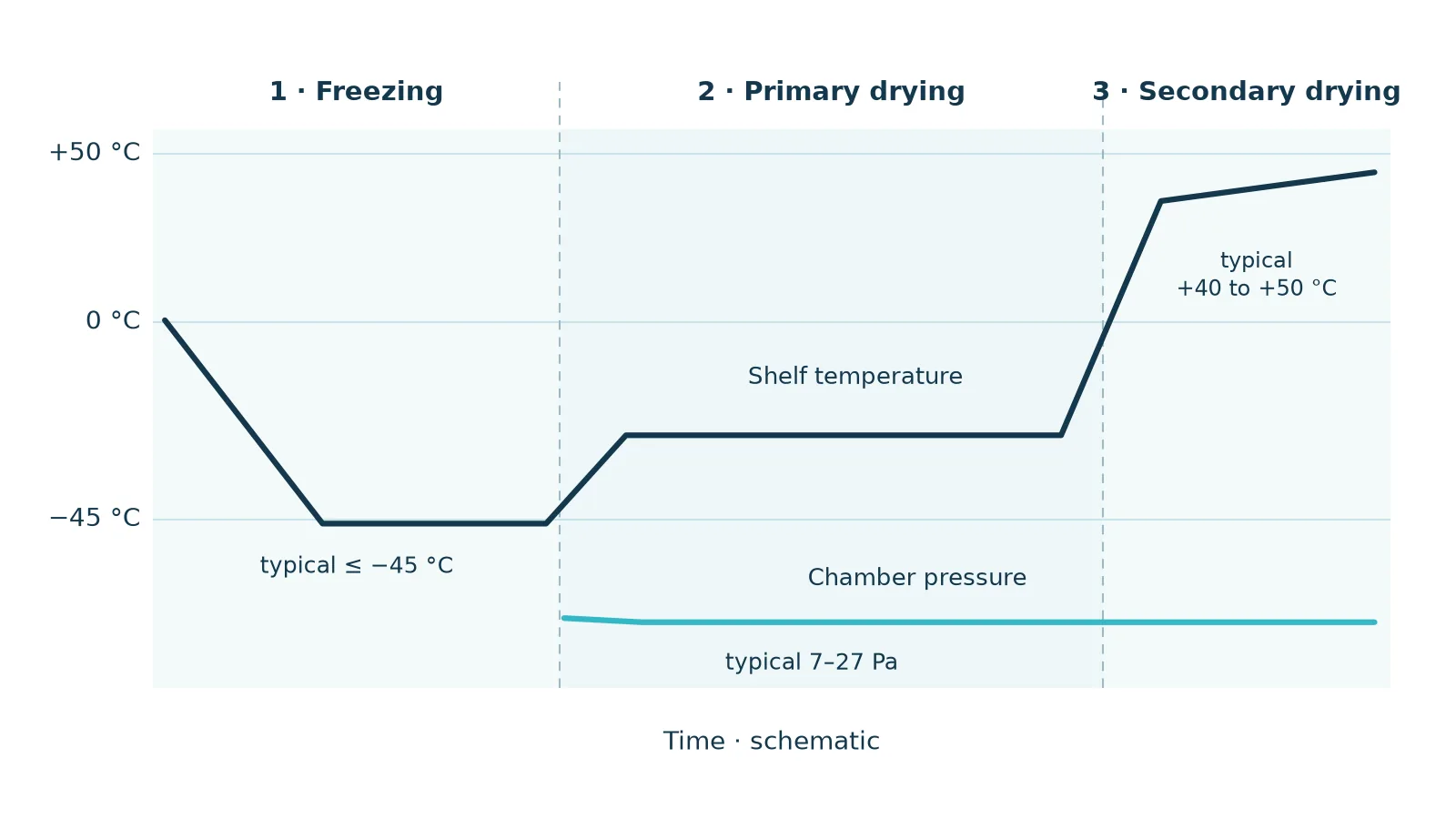
- Typical shelf at or below −45 °C.
- Typical chamber pressure 7–27 Pa; shelf below 0 °C.
- Typical shelf +40 to +50 °C at low pressure.
Freeze-drying data table
| Phase | Typical shelf temperature | Typical chamber pressure |
|---|---|---|
| Freezing | ≤ −45 °C | Not shown |
| Primary drying | Below 0 °C | 7–27 Pa |
| Secondary drying | +40 to +50 °C | Low pressure |
- 01
Freezing
The solution is cooled until its water turns to ice. In typical practice the shelf is taken to −45 °C or colder so that the product, including vials at the edge of the shelf, reaches about −40 °C. It is then held for about an hour when the fill is up to 1 cm deep, or two hours for 1 to 2 cm. Cooling at 0.5 °C per minute or slower is recommended in production to keep the product temperature even across the shelves.
- 02
Primary drying: the ice sublimes
Primary drying runs under deep vacuum, typically about 7 to 27 Pa, with about 13 to 20 Pa common. The ice sublimes, passing straight from solid to vapour, and leaves pores where the crystals were. The shelf is warmed, but in the published worked examples its setpoint stays below 0 °C: while ice is present, the product must stay a few degrees below its collapse temperature, with a margin of 2 to 5 °C depending on how long the drying takes. Older advice kept the product no warmer than about −15 °C so as not to overload the freeze-dryer; recent designs allow about −10 °C. In one published worked example on a 5% sucrose solution, raising the shelf setpoint from −25 °C to −15 °C, at a slightly lower pressure, shortened this stage from 32.5 hours to 16.6 hours.
- 03
Secondary drying: the bound water leaves
Once the ice is gone, the shelf is warmed slowly, about 0.1 to 0.2 °C per minute for amorphous solids, to about 40 to 50 °C and held for roughly 3 to 6 hours. This removes water that never froze. Residual water below 0.5% by weight is commonly reached, and chamber pressure makes little difference at this stage. Drier is not automatically better: some products are most stable at an intermediate water content.
Typical values from the pharmaceutical freeze-drying literature (Tang and Pikal, 2004; Tchessalov and colleagues, 2023), which mostly concerns sucrose and protein formulations. They illustrate the process; they do not describe the freeze-drying cycle used for any GPC product.
Why are peptides supplied as a dry powder?
Because most of the chemistry that changes a peptide needs water, and freeze-drying takes the water away.
Hydrolysis and deamidation both need water. Freeze-drying removes it, which is why a sealed lyophilized peptide changes far more slowly than the same peptide in solution. The stability guide describes those pathways and the mass shifts that reveal them.
Peptide suppliers’ handling guides make the same point from the other side. They advise against keeping peptides in solution, even sterile, oxygen-free solution, because they may slowly degrade there, and they advise holding them as the dry lyophilizate in a tightly closed container. One states simply that peptides keep for a much shorter time in solution than lyophilized.
Proteins are commonly made into dry solids by freeze-drying for the same reason, although freezing and drying can themselves stress a molecule. A dry powder changes slowly, but it does change, and moisture is the main threat to it. None of this says how long any particular material keeps.
What does the solid in the vial tell you?
The solid that freeze-drying leaves in a vial is called a cake. Its appearance tells you how it dried, not how much peptide it holds, and it varies with the formulation, the container and the process. A solid that looks unusual can still meet its quality specification.
Uniform and in one piece
The freeze-drying literature describes the ideal as a uniform, elegant cake. It suggests the product stayed below its collapse temperature while it dried.
Less elegant, not necessarily worse
If the product warms past its collapse temperature while ice is still present, the cake loses some of its structure. The literature calls such a cake less than elegant and notes that collapse can change the dissolution time and the residual water.
Fogging above the cake
A thin layer of dried material on the wall or shoulder above the cake forms when solution creeps up the glass and dries there. The freeze-drying literature calls it fogging and, in many cases, treats it as a cosmetic defect. The film is still part of the vial’s contents.
A few milligrams is very little
A few milligrams of solid, spread across the base or dried onto the wall, can look like almost nothing. One supplier notes that small quantities, especially films, can be hard to see, and advises bringing the material to the bottom of the sealed vial. Tap the closed vial or spin it briefly, look again, and ask the supplier if you are still unsure.
Appearance never tells you the amount. The certificate does.
A certificate describes appearance in words, such as “white lyophilized powder”. Where it reports the amount, it does so separately, as net content: the milligrams a laboratory measured in a tested vial of the lot. Weight is no better guide on its own. In a consensus paper on peptide standards, vials of a NIST peptide reference material filled by weight to a 1 mg target held much less than 1 mg of peptide by amino acid analysis, because salts and water travel with a lyophilized peptide.
Why let a vial reach room temperature in a desiccator before opening it?
Because lyophilized peptide takes up water from the air, and a cold vial opened in a warm room lets moisture condense on the glass and the powder.
Freeze-drying leaves a porous solid with a large surface, and peptides tend to be hygroscopic. Sequences that contain aspartic acid, glutamic acid, lysine, arginine or histidine take up moisture especially readily. One supplier’s handling guide calls this deliquescence and advises keeping such peptides in a desiccator, in tightly capped vials.
A vial from cold storage is colder than the room. When it is opened, the air that meets the cold glass and powder cools, and water condenses on them. That water stays in the vial when it goes back to cold storage, and every later weighing from the vial includes it.
The remedy is to let the closed vial reach room temperature inside a desiccator, then open it, weigh quickly and reseal it tightly. Peptide suppliers advise this, and so does a consensus paper on peptide standards, which gives the reason: it keeps the unused powder from absorbing water. The guide to preparing a stock solution shows where the step sits in the method.
- Starting powder
- 80.0% net peptide content: 1.000 mg weighed holds 0.800 mg of peptide
- After taking up water equal to 5.0% of its mass
- 80.0 ÷ 1.05 = 76.2%: 1.000 mg weighed holds 0.762 mg of peptide
Illustrative numbers, not a GPC measurement. Water in a powder is measured by Karl Fischer analysis, and the net-content guide explains how peptide, counterions and water share a powder’s weight.
Should you weigh a portion or dissolve the whole vial?
Before you prepare a stock solution by reconstitution, decide how you will know how much peptide it holds. Each route has its own uncertainty, and for sub-milligram work the difference matters.
The balance sets the floor
- What you gain: a mass measured from your own vial, with the rest left as dry powder.
- Where the uncertainty is: balance repeatability dominates small weighings, and the powder takes up moisture while the vial is open. A weighed portion also represents the vial only if the powder is uniform, which is harder to assume for small amounts that may have taken up water unevenly.
- Good practice: equilibrate first, weigh quickly and reseal tightly.
No weighing, but the amount comes from elsewhere
- What you gain: all of the material, including any film on the walls, in a measured volume, with no weighing step.
- Where the uncertainty is: the amount now comes from outside your vial: the nominal fill on the label, or a net content measured on another vial of the same lot.
- Good practice: make sure the solvent reaches any film on the walls, and confirm that everything has dissolved, by clarity, light scattering or absorbance with and without centrifugation, before relying on the concentration.
A consensus paper on peptide standards recommends dissolving a small weighed portion first, to test solubility before committing the whole amount, and keeping the rest as dry powder under argon or nitrogen, or in a desiccator, at −20 °C or colder. Where the concentration matters to a method, measure it in the prepared stock solution rather than assume it.
How small can a weighing be before the balance dominates?
Not as small as you might think. A balance’s repeatability is a roughly fixed spread, so it takes a larger share of the mass weighed as the amount shrinks.
A consensus paper on peptide standards calls weighed amounts of lyophilized peptide an uncertain basis for a concentration, because of their salt and water content and the small quantities involved. The balance adds its own share.
USP chapter 〈41〉 sets a minimum weight for pharmacopoeial weighing: twice the standard deviation of repeated weighings may not exceed 0.10% of the amount weighed. In one published worked example, a semi-micro balance reading to 0.01 mg showed a standard deviation of 0.041 mg, which puts its minimum weight at 82 mg by that criterion. The criterion does not bind research weighing, but it shows the scale of the problem.
On that balance, a spread of two standard deviations is 0.082 mg:
- Balance spread on a 5 mg weighing
- 0.082 mg, or 1.6% of the mass weighed
- Balance spread on a 1 mg weighing
- 0.082 mg, or 8.2% of the mass weighed
- Balance spread on a 0.5 mg weighing
- 0.082 mg, or 16.4% of the mass weighed
One balance, for illustration. A laboratory measures the repeatability of its own balance, and moisture taken up during weighing widens the spread further.
Can a peptide solution be freeze-dried again?
Yes, but the dried solid that comes back is no longer the powder you started with.
Peptide suppliers’ handling guides describe freeze-drying surplus solution to hold it dry, and re-drying as a way back when a first solvent fails. A consensus paper on peptide standards treats surviving one freeze-drying and redissolving step, with less than 3% loss and no modified residues, as a property to establish for a standard peptide rather than to assume.
Three things change:
- What stays behind. Volatile acids such as TFA, acetic, formic and hydrochloric acid leave with the water, and so do volatile additives such as ammonium acetate, ammonium formate, ammonium bicarbonate and ammonium hydroxide. Phosphoric acid does not, and other non-volatile salts stay in the dried solid.
- The pH on the way down. Freezing a buffered solution can shift its pH sharply before any drying begins. In one study, sodium phosphate buffer at 50 to 100 mM and pH 7.4 reached pH 4.2 at −10 °C.
- The peptide itself. Each round of drying and redissolving risks some loss or modification, and the literature on counterion exchange notes that the repeated hydrochloric acid route can degrade a peptide.
Record the solvent and every non-volatile additive, the volume and concentration of the solution that went in, and the date. Treat the dried material as a new preparation rather than the supplier’s powder: its mass now includes new salts and a new water content, so track the amount from the solution record instead of weighing the re-dried solid.
What about transit and arrival?
For a sealed vial of dry powder, cold in transit is generally not the concern: freezing does not act on a dry powder the way it acts on a solution. Heat is the variable to watch. The stability guide covers Canadian winters and summers, the storage of lyophilized peptides and what to do if a parcel arrives warm; the shipping page explains delivery in Canada and how to report a damaged parcel.
On arrival, note the condition of the package and the lot number, and move the vials promptly to cold, dry, dark storage.
Common questions about lyophilized peptides.
What is lyophilization, and why are peptides supplied as powder?
Lyophilization, or freeze-drying, removes water from a frozen solution in three stages: freezing, primary drying under vacuum, and secondary drying. Most chemical changes in a peptide need water, so the porous dry solid it leaves changes far more slowly than a solution, and suppliers advise keeping peptides in that form. That describes the chemistry, not how long any particular material keeps.
Why does the vial look empty, or show a film on the glass?
A few milligrams of solid is very little: spread across the base or dried onto the wall, it can look like a thin film or like nothing at all. A film above the main cake, called fogging, forms when solution creeps up the glass before it dries, and is often cosmetic. Neither tells you the amount; the certificate’s net content, measured on a tested vial of the lot, does.
Does a lyophilized peptide give a homogeneous solution?
Only once all of it has dissolved and mixed. Material can sit as a film on the walls or shoulder, or be scattered in transit, so tap or briefly spin the closed vial before opening it, and make sure the solvent reaches any film on the walls. A concentration applies only to peptide that has fully dissolved, so confirm that the solution is completely clear before relying on it.
Why are peptides hygroscopic, and how does absorbed water change a weighed amount?
Freeze-drying leaves a porous solid with a large surface, and sequences that contain aspartic acid, glutamic acid, lysine, arginine or histidine take up moisture from the air especially readily. Water taken up is weighed as if it were powder: a powder at 80% net peptide content that gains water equal to 5% of its mass falls to about 76%. The numbers are illustrative, not a GPC measurement.
Is a sub-milligram weighing more reliable than dissolving the whole vial?
Not necessarily; each route has its own uncertainty. Below about a milligram, the balance’s repeatability becomes a large share of the mass weighed, 8.2% of a 1 mg weighing in one worked example, and moisture taken up while weighing adds to it. Dissolving the whole contents in a measured volume avoids the balance, but the amount then comes from the label or from a net content measured on another vial of the lot. Where the concentration matters to a method, measure it in the prepared stock solution.