
For instructors and laboratory coordinators
Peptide HPLC exercises for teaching laboratories.
Short synthetic peptides make good teaching material for chromatography and mass spectrometry. They are well-defined molecules with known sequences and masses, they respond clearly at common UV wavelengths, and they show the separation and identification problems students will meet in working laboratories. These exercises are written for instructors and laboratory coordinators planning supervised analytical courses.
For supervised laboratory teaching and research use only. Not for human or veterinary use.
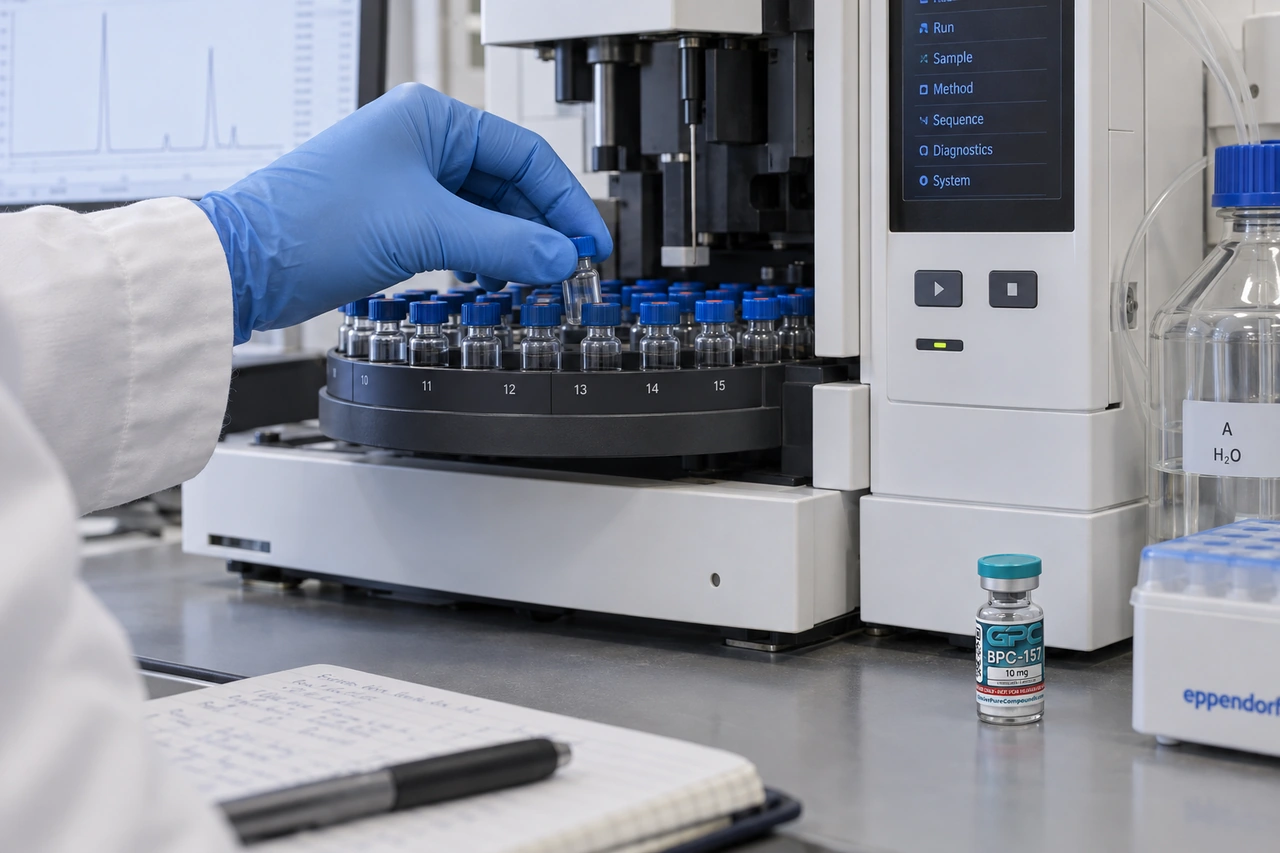
In this guide
Why teach chromatography with peptides?
Because a peptide gives students a molecule they can predict and then check.
From a sequence, a student can calculate the expected mass, count the basic residues that will carry charge and predict roughly how the peptide will behave on a reversed-phase column. The instrument then tests each of those predictions. That loop of prediction and measurement is the skill an analytical course is trying to build.
One well-characterized peptide supports several learning outcomes:
- separation: how the gradient, column and mobile phase change retention and resolution;
- quantitation: how integration choices and detector settings produce a purity figure;
- identification: how a mass spectrometer reports charge states and how they convert to a mass;
- recordkeeping: how a lot number, a method and a result stay connected from bench to report.
Which exercises work well?
Each exercise fits a single laboratory period and uses the same material, so results can be compared across sections and terms. All of them start from a stock solution of known concentration, prepared and recorded before the first run.
System suitability
Students make six replicate runs of one solution and calculate the relative standard deviation of retention time and peak area. It introduces the idea that an instrument has to show it is performing before any sample result means anything.
Gradient slope and resolution
Run the same sample with a shallow and a steep acetonitrile gradient. Students measure retention, peak width and the resolution between the main peak and its nearest impurity, and see why method development trades time against separation.
Integration and the purity figure
Give every group the same chromatogram file and ask each to integrate it. Different baseline placements and peak thresholds produce different purity figures from identical data, which is the most memorable way to learn why a certificate should show its chromatogram.
Mobile-phase modifiers
Compare TFA and formic acid in the mobile phase. TFA usually gives sharper peaks on UV but suppresses the LC-MS signal; formic acid tends to do the reverse. Students see that a method choice is a compromise with a reason behind it.
Charge states and mass
From an LC-MS spectrum, students identify the singly, doubly and more highly charged ions, calculate the neutral mass from each and compare it with the mass listed for the compound. Off-by-one-proton errors are common, instructive and quick to catch.
A short stress study
Hold one solution at room temperature and treat another with dilute hydrogen peroxide, then analyze both against a cold control. New peaks, and a 16 Da mass shift when the sequence contains methionine, connect the chromatogram to the chemistry.
What makes a peptide easy to teach with?
The choice of material belongs to your institution’s risk assessment. These are the analytical properties that make a peptide straightforward in a teaching laboratory.
Values students can look up
A CAS number, molecular formula and molecular mass let students check their calculated values against a published reference. The GPC compound library lists these for every compound in the catalog.
Aromatic residues help
Every peptide absorbs near 214 nm through its backbone, but tryptophan or tyrosine adds absorbance at 280 nm. A second wavelength gives students a check on peak identity and a reason to think about chromophores.
Short and moderately charged
Peptides of roughly 5 to 20 residues usually give clean spectra with two or three charge states. Very short or very hydrophilic peptides can elute close to the solvent front on a standard C18 column.
Lot results to compare against
A lot with published results lets students compare their own purity figure and mass with a laboratory’s, then explain any difference. That discussion is often the best part of the session.
How do you supply a course from one lot?
Using one production lot for the whole course keeps results comparable between sections.
- 01
Order under a responsible instructor
The person placing the order must be at least 21, authorized to order for the institution and responsible for the material. Students handle it only with suitable training and under supervision, as part of the course’s risk assessment.
- 02
Choose a research kit for one lot
A GPC research kit holds ten vials of one fill, and every vial carries the same lot number as the box. One kit can supply every section with consistent material and a single lot record to compare against.
- 03
Budget per milligram
Product pages show the price per vial and per milligram in Canadian dollars, with volume tiers for additional kits. GST/HST is calculated for the delivery address at checkout, and every order ships from GPC’s Canadian warehouse.
- 04
Store and account for it
Keep vials sealed at −20 °C or colder between sessions, log each vial as it is issued, and dispose of unused material and solutions under your institution’s procedures.
- 05
Record the lot in every report
Have students record the lot number with each result. It teaches traceability and lets next term’s class compare its results with this one’s.
What are the limits of teaching use?
Supervised analytical teaching is one of the uses the GPC Research Use Policy names. It covers separation, identification, measurement, uncertainty and laboratory recordkeeping, with materials chosen through the institution’s risk assessment.
Treat every research material as potentially hazardous. Many research compounds are not fully characterized, and the absence of a warning is not an indication of safety. Material stays in the laboratory and is used only for the analytical exercises in the course plan.
Material is supplied for the purchaser’s own laboratory work and may not be resold or transferred outside the institution without GPC’s written agreement.
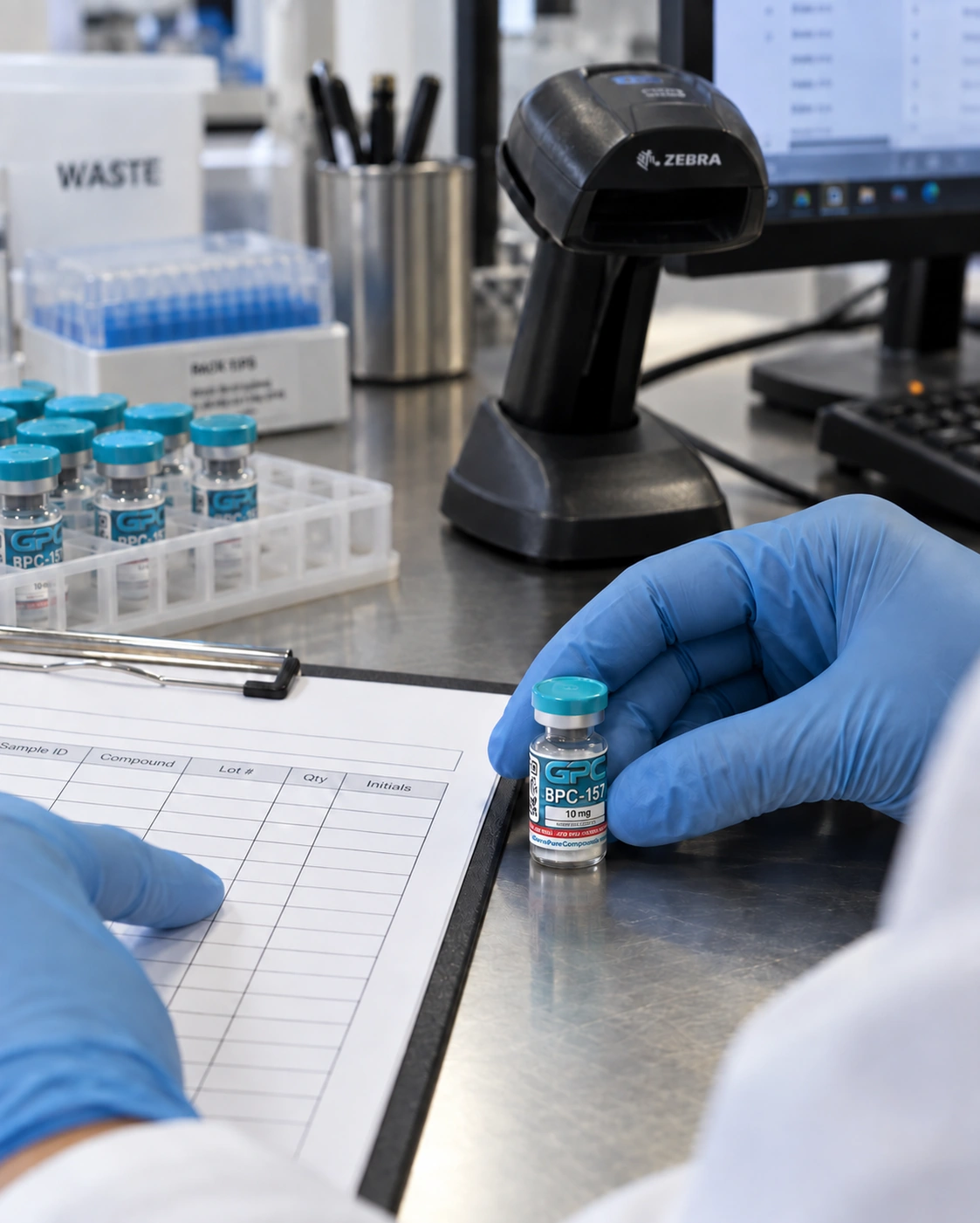
Common questions about peptides in teaching laboratories.
Can a college or university order from GPC?
Yes. Educational institutions are among the eligible purchasers under the Research Use Policy. The person placing the order must be at least 21, authorized to order for the institution, and responsible for the material and its supervision.
Which HPLC column suits a peptide teaching laboratory?
A standard reversed-phase C18 column with a water and acetonitrile gradient containing 0.1% TFA or formic acid handles most short peptides. Wide-pore columns become useful for larger peptides.
How much peptide does a teaching laboratory need?
Very little. Each HPLC-UV run typically uses micrograms of material, so one vial prepared as a stock solution can supply many runs. Plan the preparation so each session uses fresh aliquots rather than one solution kept for weeks.
Does GPC provide lot documentation students can use?
Yes. Every lot offered for sale has published results for its production batch, with the issuing laboratory named, and each vial label carries the lot number and a QR code that leads to that record.