
Frequently asked questions
Answers before you order.
Start here for clear answers about who can order, pricing, lot testing, payment, Canadian shipping, storage and returns.
If your question is about a specific order or lot, contact support.
Products, pricing and buying in Canada
Where can I buy research peptides in Canada?
GPC is a Canadian supplier. Customer orders are checked, labelled, packed and shipped from GPC’s warehouse in Canada to Canadian addresses.
- Canadian warehouse, 1-2 business days to process: local inventory suited to smaller or time-sensitive orders.
- GPC Distribution Center, typically 5-6 weeks end to end: suited to research kits and larger planned orders. The order reaches GPC’s Canadian warehouse for final verification, labelling and packing before delivery to your lab.
When both sources are available, the catalog lets you choose. Confirm laboratory research use to view products and prices.
Is GPC a Canadian company?
Yes. GPC is operated by Viking Media Labs Inc. from Kitchener, Ontario.
Prices are in Canadian dollars, and every customer shipment leaves GPC’s Canadian warehouse for a Canadian delivery address.
How much do research peptides cost at GPC?
Every product page shows the price for one sample vial, a 10-vial research kit and the available wholesale tiers. It also shows the cost per vial and per milligram so products are easier to compare.
All prices are in Canadian dollars. GST or HST is calculated at checkout. You do not need to request a quote to see the published prices.
Why are kit prices lower than singles?
A research kit contains 10 labelled vials of the same product and fill amount from the same production lot. One kit costs significantly less than buying 10 individual sample vials.
Kit tiers are 1–9, 10–19 and 20+ kits of the same product and fill on one order line. The selected rate applies to every kit on that line. Discounts vary by product, and some kit prices stay the same across tiers. Different fills or order lines do not combine.
What peptides does GPC carry?
The catalog shows the products currently offered, their fill amounts, available formats, fulfillment-source availability and the testing data published for each lot.
Availability changes as new lots are accepted and older lots sell out or are withdrawn, so the catalog is the current source of truth.
Is it legal to buy research peptides in Canada?
Peptides have legitimate laboratory uses. Whether a particular product may be sold in Canada depends on the substance, why it was made, how it is offered and the rules that apply to it. A research-use-only label does not answer those questions by itself.
GPC’s offer is for qualified laboratory work and supervised analytical teaching. The products are not offered for personal use, use in or on people or animals, patient testing or treatment. Any drug, prescription or import requirements that apply must still be met.
Our guide to research peptide legality in Canada explains these distinctions step by step and links to the official sources. It provides general information, not legal advice.
What should a certificate of analysis show?
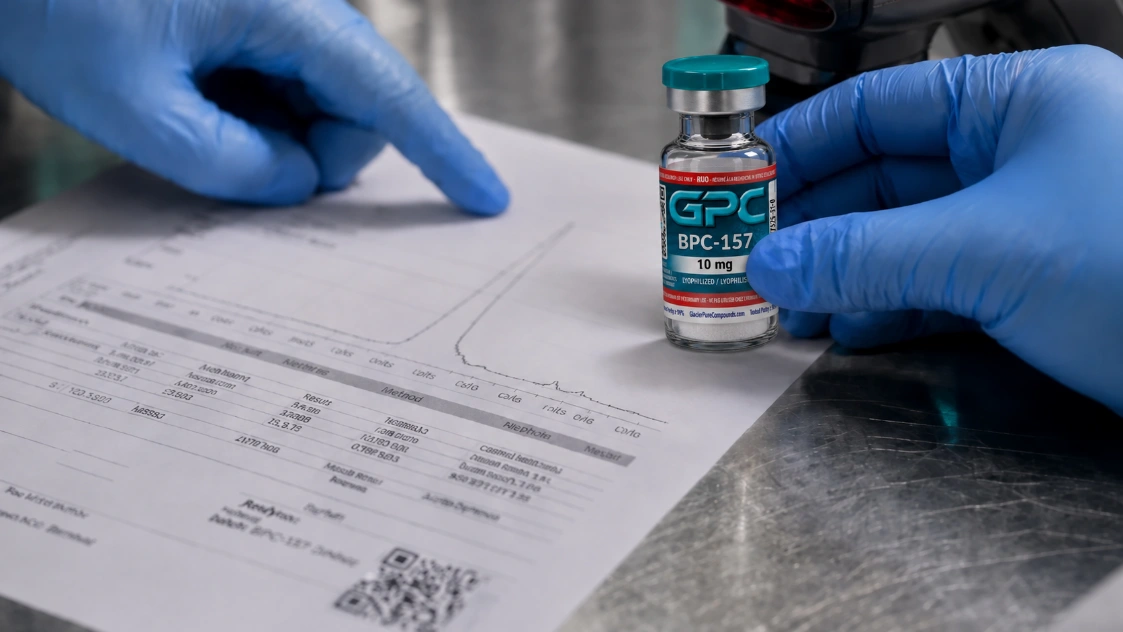
A useful certificate of analysis, or COA, should let you answer five basic questions:
- Which sample or production lot was tested?
- Which laboratory issued the report?
- Which test method was used?
- What values did the laboratory report?
- How can the report be confirmed with the laboratory?
Supporting pages may include a chromatogram, which is the graph behind a chromatography result, and mass data used to support identity. Laboratories use different layouts and names, so focus on whether the report connects the result, method, laboratory and tested lot. GPC publishes the available independent supply-chain testing data tied to every lot it offers.
How do I compare prices between peptide suppliers?
First compare the same product, fill amount and order format. Then compare cost per vial and cost per milligram. To find cost per milligram, divide the vial price by the number of milligrams in the vial.
- A 5 mg vial at $40 costs $8.00 per milligram.
- A 10 mg vial at $60 costs $6.00 per milligram.
In this example, the 10 mg vial costs more in total but less for each milligram. Also compare kit discounts, volume tiers, shipping charges, taxes and the testing data tied to the lot. GPC calculates the per-vial and per-milligram figures on every product page.
Is it better to buy peptides domestically or import them?
A domestic order keeps the seller, currency, order record and final shipment inside Canada. That can make costs, support and delivery planning easier to understand.
That is logistics, not a finding that the product is outside Health Canada’s reach. Canadian regulatory requirements still apply.
An imported order can add international transit, currency conversion, brokerage, duties and customs uncertainty. Compare the complete delivered cost and realistic lead time, not only the listed product price. GPC prices in Canadian dollars and ships customer orders from Canada.
What does research use only mean?
It means the material is supplied only for controlled laboratory research by qualified adults. It is not for personal, household, clinical, diagnostic, human or veterinary use.
GPC requires this confirmation before the catalog opens and again at checkout. The label describes the permitted purpose of GPC’s offer. It does not create a legal exemption or replace any approval, licence or rule that applies to your organization or project.
Do you ship peptides across Canada?
Yes. GPC ships customer orders to Canadian addresses only. Standard shipping is CAD $34.99 and is free when the merchandise subtotal reaches CAD $999 before tax. The minimum order is CAD $250 in merchandise after discounts, before shipping and tax.
- Canadian warehouse inventory is usually processed in 1-2 business days.
- GPC Distribution Center orders typically take 5-6 weeks end to end.
These are planning estimates, not guaranteed delivery dates. The product page and checkout show the source and current estimate before payment.
Who can order and why access is restricted
Who can buy from GPC?
GPC supplies qualified Canadian research buyers, including:
- independent laboratories
- institutional researchers
- educational institutions
- research organizations and companies
Purchasers and catalogue users must be at least 21, with suitable laboratory facilities, trained personnel or direct supervision, and authority for the actual work. A title, affiliation or checkbox alone does not establish qualification.
Are products intended for human or veterinary use?
No. GPC products are for laboratory research only. They are not offered for human, veterinary, personal, household, clinical or diagnostic use.
Every customer confirms the restriction before viewing the catalog and again at checkout.
Why does the catalog require an attestation?
The confirmation records your age, laboratory qualifications, lawful research purpose and agreement to the research-use and sale terms, with acknowledgement of the Privacy Policy. It is required before catalogue access and renewed for each order.
It records your commitments; it is not independent verification of credentials or a regulatory authorization. GPC may seek more information or refuse, hold or cancel an order where the laboratory context cannot reasonably be established.
Can your team advise on protocols or outcomes?
No. GPC support can explain catalog facts, product formats, pricing, fulfillment, order status, shipping and published lot records.
GPC does not choose your method, provide experimental protocols, interpret results for your project or predict outcomes. Your research team is responsible for its own qualified procedures, facilities, risk assessment and legal requirements.
Which laboratory uses are permitted?
Examples include chromatography and mass-spectrometry methods, analytical response and recovery studies, carryover checks, stability and adsorption studies, suitable non-clinical in vitro or cell-free work, supervised analytical teaching and method comparisons. The Research Use Policy gives the scope and conditions.
Each laboratory must establish suitability of the actual material for its method. GPC does not represent every vial as a certified reference material, validated instrument calibrant or diagnostic reagent. Administration to humans or animals, clinical work and personal use are prohibited.
Lot testing and the GPC Verification Program
Does every lot receive every verification checkpoint?
Every lot offered for sale must pass two published inventory rules:
- Publishable laboratory results from the production batch certificate must be available for the lot.
- A reported purity result below GPC’s 99.00% inventory-acceptance threshold is not accepted into inventory.
Other supplier and source checks are risk-based, so GPC does not claim that every lot receives every possible test panel. The lot page shows the evidence actually available for that lot. The 99.00% rule is an inventory-acceptance standard, not a guarantee that every vial was individually tested or will produce the same result later.
What do the published lot results show?
Before GPC accepts a production lot into inventory, it reviews the available certificate issued by the laboratory engaged by the manufacturer for a sample from that batch. The report may include:
- identity
- appearance
- reported purity
- net content
- the methods used
- component results for blends, when reported
GPC transcribes the available values and names the issuing laboratory on the lot page. These results describe the sample tested at that point in the supply chain. They are not a direct test of the vial delivered to you, a safety assessment or a promise that later testing will be identical.
Does GPC commission its own test for every lot?
No. GPC does not present GPC-commissioned COA data for all products. Every offered lot has publishable results issued by the laboratory engaged by the manufacturer for the production batch, and GPC reviews the reported values before accepting the lot. Some lots may also have additional testing commissioned by GPC or submitted by a customer, and those results are identified when available.
GPC publishes the available analytical values on the lot page and links matching public COAs through COA Coalition as supply-chain test results. For these records, use the source’s BATCH / SEARCH CODE as the GPC lot number to match the certificate verification link. Results for other lots remain available with their existing identifiers.
Customers can add another evidence layer by testing a vial from their own delivered research kit through the GPC Verification Program.
Does every lot have published batch results?
Yes. A lot is not offered for sale until publishable batch results exist for it.
Match the GPC lot number on your vial to the lot page. Results from a different lot do not describe the material you received. Remember that the published data describe the sample tested during supply-chain verification, not every vial after later shipping, storage or handling.
Can I arrange my own testing?
Yes. The GPC Verification Program applies to one vial per product SKU, meaning one product and fill amount, from an eligible delivered 10-vial research kit. Individual sample-vial purchases are not eligible.
- Request written pre-approval from your GPC account before sending or testing any vial.
- Approved third-party laboratories are Testides, Sidechain Analytics, and Peptide Test Canada. Use the laboratory or qualified in-house method named in your approval.
- Make sure the final report is dated before 60 days have passed from delivery.
- Submit the report, labelled-vial photograph and every record named in the approval.
After GPC validates a complete submission, the price paid for the tested vial is issued as account credit. Pre-approved third-party fees for identity, net content and purity can also be credited. Optional panels such as endotoxin or heavy metals are allowed, but their laboratory fees are not credited. An approved in-house analysis receives the vial credit only because there is no third-party invoice.
A qualifying failed result from an approved third-party laboratory can trigger an Interac refund for that product from the affected order under the program terms. Written pre-approval and the full program terms control every request.
How does account credit work at checkout?
Approved Verification Program credit is recorded on your GPC account. When you are signed in, checkout can apply it to reduce the amount you pay. GST or HST is still calculated on the full merchandise value.
- Credit is not cash and cannot be transferred to another account.
- Credit applied to a cancelled or expired unpaid order returns to your balance.
- Credit normally expires 12 months after issue unless the written approval or applicable law requires something different.
- Checkout uses the credit closest to expiry first.
Your account credit page shows the amount, history and expiry date of each credit.
Payment, fulfillment, storage and returns
What is a research kit?
A research kit contains 10 labelled vials of the same product and fill amount from the same production lot. Kit quantity is entered in kits, not vials.
- When the quantity of one product SKU, meaning the same product and fill amount, reaches a volume tier, every kit on that line receives the published rate for that quantity. Some products keep the same price across tiers.
- Different products or fill amounts do not combine toward a tier.
- Individual sample vials use a separate price.
Is there a minimum order amount?
Yes. The minimum order is CAD $250 in merchandise after discounts, before shipping and tax. You can combine different products to reach this order minimum.
Free Canada-wide shipping starts at CAD $999 in merchandise after discounts, before tax. These thresholds apply to the merchandise in the full order, regardless of the payment schedule selected.
How do I pay?
Choose your payment method and schedule at checkout. GPC creates a PDF invoice showing the complete order total, exact amount due now, any later balance and a unique reference. For Stripe, use the link provided with your order, enter the amount due and your order number, then pay on Stripe. Payment is confirmed automatically when Stripe notifications are connected, or after our team verifies it. Choose Interac e-Transfer or pay by card through a secure Stripe payment link. GPC creates your invoice and manages your order; Stripe only receives payment. Full payment is preferred and selected by default.
When banking limits require it, you may send multiple transfers using the same unique order reference. Each confirmed transfer appears in your payment history and reduces the amount due. An Interac request with no confirmed payment expires after 72 hours. Stripe orders remain open for payment verification; do not pay again while a successful payment is awaiting confirmation. Once a partial payment is confirmed, the order stays open for additional transfers, but processing does not begin until their cumulative total reaches the required initial payment.
When the installment schedule is selected, Canadian warehouse items and shipping are paid in full initially, 50% of Distribution Center item totals starts processing and their delivery timeline, and the remaining 50% is due before those items ship. Payment is made to Viking Media Labs Inc., which operates as Glacier Pure Compounds.
Where do you ship?
GPC ships customer orders to Canadian addresses only. Every parcel leaves GPC’s warehouse in Canada.
Standard shipping is CAD $34.99 and is free at a merchandise subtotal of CAD $999 before tax. GST or HST is calculated from the delivery address at checkout. The minimum order is CAD $250 in merchandise after discounts, before shipping and tax.
What is the difference between the two fulfillment sources?
The price for the same product format and quantity is the same from either source. The difference is where inventory is prepared and how long fulfillment normally takes.
- Canadian warehouse: local inventory that is usually processed in 1-2 business days. It is best for smaller or time-sensitive orders, but quantities are limited and change quickly.
- GPC Distribution Center: best for multiple research kits and larger planned orders. Delivery typically takes 5-6 weeks end to end, including final verification, labelling and packing at GPC’s Canadian warehouse.
The catalog shows availability separately for each source. A 10-vial research kit can be selected only when at least 10 vials remain in the source you choose.
Why would I choose the longer fulfillment option?
The GPC Distribution Center is designed for planned procurement of multiple research kits and larger inventory quantities. The local Canadian warehouse holds a smaller pool intended for faster, lower-volume orders.
Plan large project needs in advance. The longer window gives access to greater volume while keeping the same published product price and wholesale tiers.
Why is Canadian warehouse availability so limited?
Local warehouse inventory is positioned for faster dispatch, not large order volume. Quantities are intentionally smaller and change quickly as orders are placed.
For planned research-kit procurement or larger inventory requirements, use the GPC Distribution Center when it is available.
How is material stored, and how should I store it?
GPC holds distribution inventory at -20 °C or colder, with moisture control and protection from light. Before shipping, selected vials are brought toward ambient temperature under a monitored acclimation process rather than a sudden temperature change.
For longer storage at your facility, use qualified procedures and the product-specific information available to your team. Common controls for lyophilized research peptides include:
- a stable -20 °C to -80 °C environment
- protection from moisture and light
- avoiding repeated temperature changes
- allowing a sealed cold vial to warm gradually before opening so moisture does not condense inside
Exact handling can vary by compound, method and research setting. GPC does not prescribe an experimental protocol.
Can shipped vials be returned?
Shipped vials cannot be returned for restocking or resale. Once a vial leaves GPC’s controlled custody, GPC cannot verify its tamper status, temperature, light exposure, moisture exposure or handling.
Report an incorrect, damaged or lost shipment within 14 calendar days of delivery or the expected delivery event. Keep the material and packaging while the claim is reviewed, and do not send anything back unless GPC provides written instructions. The Refund and Return Policy states the complete process.
Detailed guides by topic
Use these guides when you need more context than a short FAQ answer can provide. Each guide explains one subject from the beginning and links to the relevant policies or sources.