
Laboratory solution preparation
Peptide reconstitution and dilution calculator.
This calculator works out the concentration of a laboratory stock solution prepared by reconstitution of a lyophilized peptide, and the volumes for the working solutions and dilution series made from it. You enter every value yourself. Below the tool, the page explains the arithmetic and the bench limits on each number: net content, molecular weight, pipetting precision, displacement and container capacity.
For laboratory research use only. Not for human or veterinary use.
On this page
Laboratory solution calculator
This tool calculates concentrations for laboratory solutions. GPC gives no administration advice.
General laboratory information.
Vial tint is illustrative; concentration sets its opacity on a logarithmic scale.
How are mass, volume and concentration related?
Concentration is the amount of peptide divided by the volume of the finished solution.
The volume is the volume of the solution, not the volume of solvent added. NIST’s guide to SI usage defines a concentration against the volume of the mixture, and a mass concentration is simply a mass divided by that volume, written in mg/mL or µg/mL.
The calculator works in both directions:
- Concentration = amount ÷ volume. Enter an amount and a solvent volume, and the stock solution mode gives the concentration.
- Volume = amount ÷ concentration. Enter an amount and a target concentration, and the same mode gives the solvent volume that reaches it.
In the laboratory, reconstitution turns a known amount of lyophilized peptide into a stock solution, and every later concentration on this page follows from that amount and that volume.
Every conversion between mass concentrations is an exact power of ten: moving between mg/mL and µg/mL multiplies or divides by 1000 and changes nothing else.
In a volumetric flask filled to its mark, the final volume is exact. In a vial, it is the solvent volume plus the small volume the dissolved peptide itself occupies. Below about 14 mg/mL that extra is under 1% of the volume, and the displacement section below covers the rest.
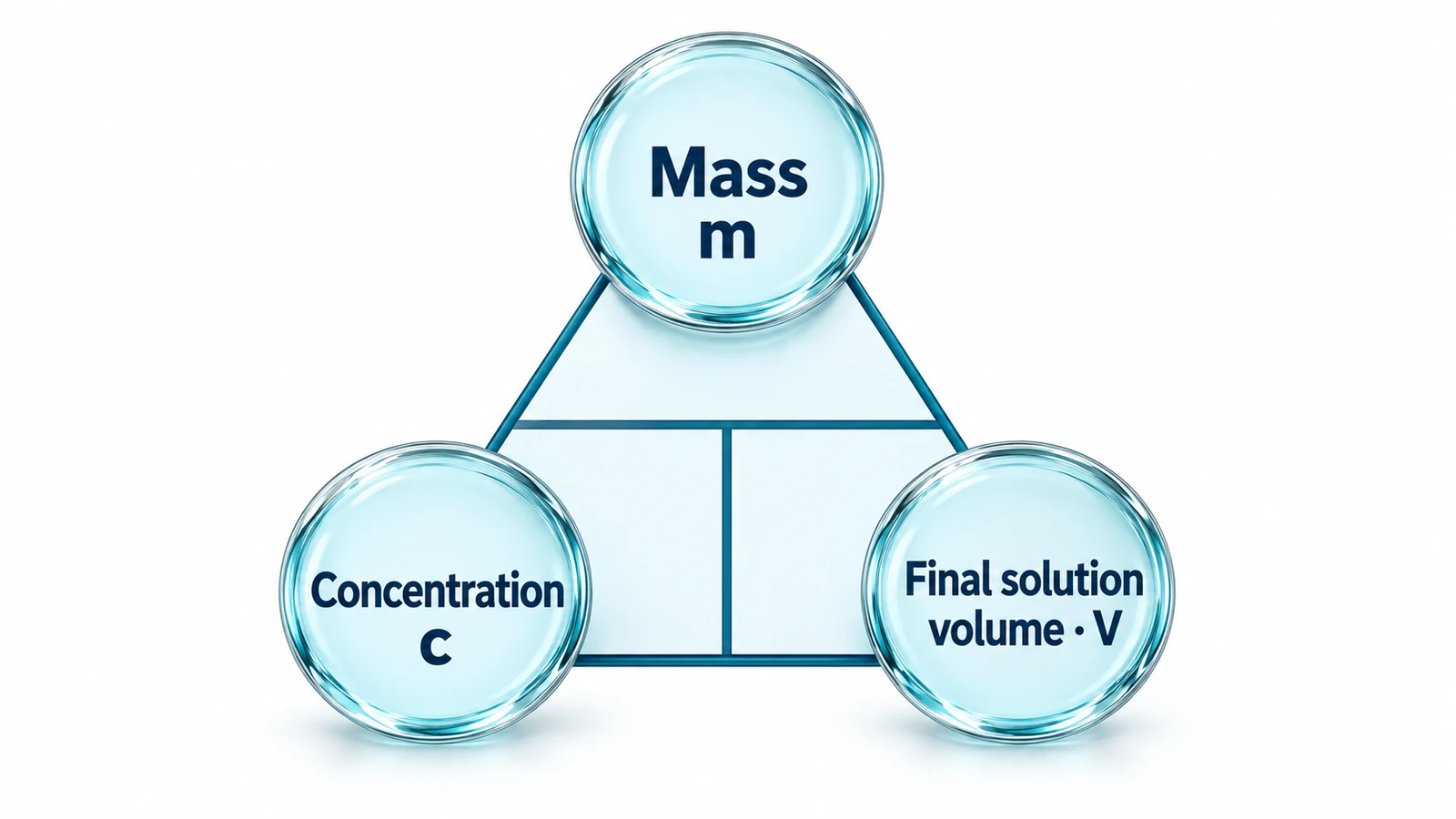
- Massm
- Concentrationc = m ÷ V
- Final solution volumeV
- mg/mL
- Milligrams per millilitre, the same as grams per litre
- µg/mL
- Micrograms per millilitre, the same as milligrams per litre; 1 mg/mL is 1000 µg/mL
- mM, µM, nM
- Millimoles, micromoles and nanomoles per litre, which need a molecular weight
- NIST SP 811, §8.6.5
- Concentration is defined against the volume of the mixture
Does adding solvent add peptide?
No. Adding solvent adds volume, never peptide.
The amount of peptide is fixed by what was weighed or what the container held. Solvent changes only the volume that amount is spread through, so the concentration falls in proportion as the volume rises: twice the volume, half the concentration. A larger volume can look like more material. It is the same material, spread thinner.
Two ways to picture it:
- Ink in two flasks. Put one drop of ink in a 10 mL flask and an identical drop in a 100 mL flask. Both hold the same ink, and the larger looks ten times paler because the same ink is spread through ten times the liquid. Filling the flask to the mark adds liquid, not ink.
- Forty marbles, two trays. Tip forty marbles into a small tray, then move the same forty into a tray four times the size. Nothing has been added or lost, but any one square of the large tray holds a quarter as many. Spreading them out never makes a forty-first marble.
Dilution also changes how dependable a solution is. Container walls can bind only a limited amount of peptide, so the share lost to the wall is small in a concentrated solution and large in a dilute one (Hoofnagle et al., 2016). In one manufacturer’s peptide calibration mixture, three of fifteen peptides gave 20 to 60% lower signal when stored at the lower concentration, and the manufacturer describes the more concentrated version as better suited to quantitative dilution curves.
That is why stock solutions are kept concentrated, and working solutions are diluted from them as close as possible to the time the method runs. The storage guide covers container surfaces and low concentrations in detail.
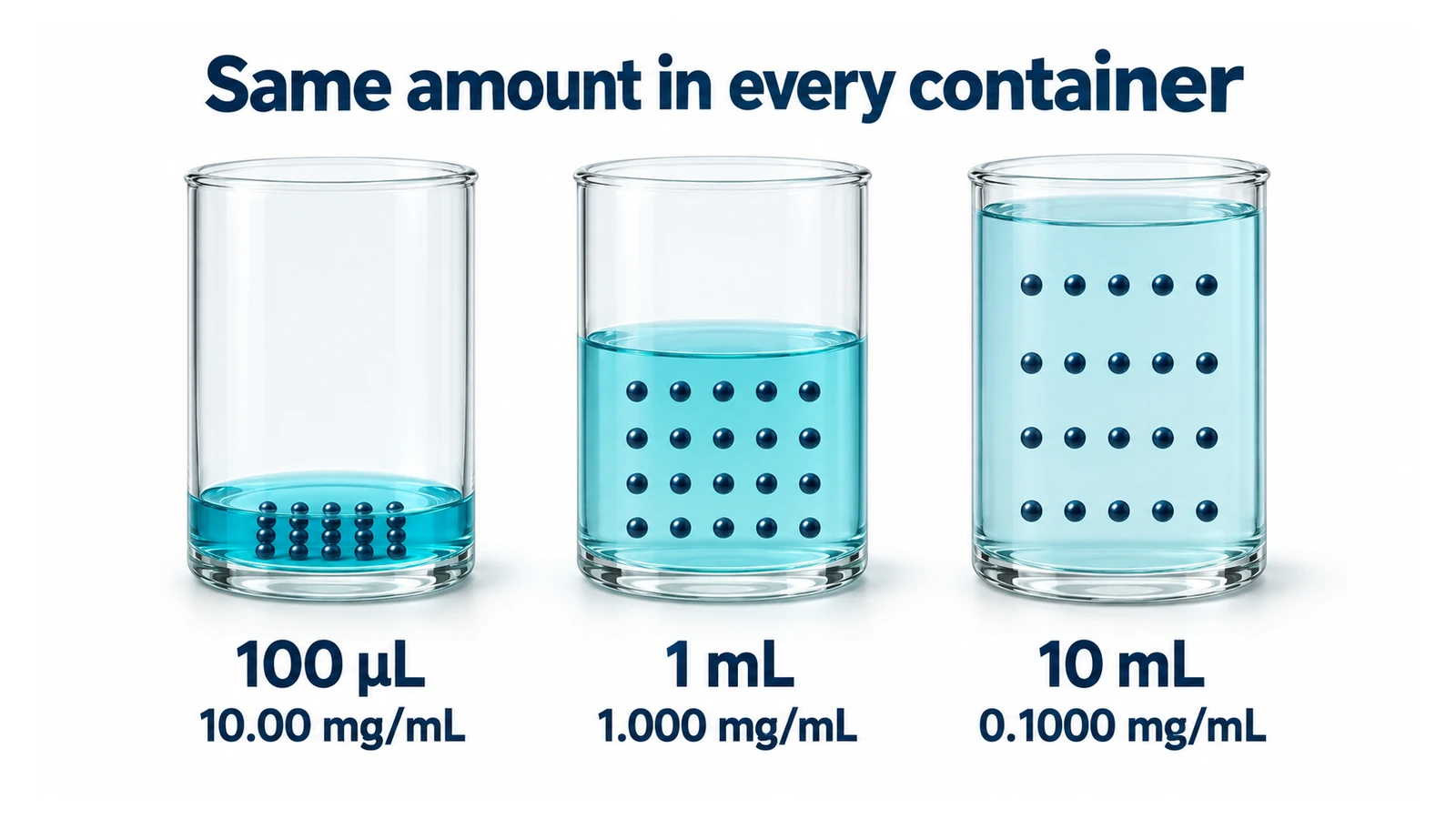
- 100 µL10.00 mg/mL
- 1 mL1.000 mg/mL
- 10 mL0.1000 mg/mL
When does a calculation need the molecular weight?
Only when the concentration is molar. A molar concentration counts molecules rather than milligrams, and the molecular weight converts one into the other.
Molar concentration is amount of substance per litre: mM is millimoles per litre (mmol/L), µM micromoles per litre and nM nanomoles per litre. NIST describes the word “molarity” and the bare symbol M as obsolete, but mM, µM and nM remain the ordinary laboratory shorthand, and the calculator uses them in that sense.
The conversion follows from the definitions. Because 1 mg/mL is 1 g/L, dividing a mass concentration by the molecular weight in g/mol gives mol/L, and the factors below scale that to mM, µM or nM. Peptide A at 5.000 mg/mL, with a molecular weight of 1,250.0 g/mol, is at 4.000 mM, or 4,000 µM.
The molecular weight must match the basis of the amount. Net peptide content already excludes counter-ions and water, so a net peptide mass or a measured peptide content pairs with the free peptide’s molecular weight, the value calculated from the sequence. If a certificate gives a salt or batch molecular weight, it belongs with the gross powder mass, never with net content.
The difference is not small. HPLC-purified peptides usually arrive as trifluoroacetate (TFA) salts. Each TFA counter-ion adds about 114 g/mol, and each acetate about 60 g/mol. A 1,200 g/mol peptide with two TFA counter-ions weighs about 1,428 g/mol as the salt. Pairing the free peptide’s weight with a mass of the salt overstates the molar concentration by about 19%, and pairing the salt’s weight with a net peptide mass understates it.
- µM
- mg/mL ÷ molecular weight (g/mol) × 1,000,000
- mM
- mg/mL ÷ molecular weight (g/mol) × 1000
- nM
- mg/mL ÷ molecular weight (g/mol) × 10⁹
Net peptide content and purity: multiply, do not choose
The amount in a calculation should be the amount of intended peptide, and the weighed powder is not all peptide.
The gross mass of a peptide powder is the peptide plus its counter-ions and the water it holds. Net peptide content is the peptidic share of that mass, measured by amino acid analysis, nitrogen content or UV spectrophotometry, and it counts peptidic impurities along with the intended peptide. HPLC purity is the intended peptide’s share of the peak area at about 220 nm: it compares the species that absorb there with each other, and it weighs nothing.
The calculator takes the amount on one of three bases and names the basis it used:
- Label amount: the nominal fill printed on the container. It is a declared figure, not a measurement of that container.
- Measured content from a certificate: the amount of peptide a laboratory measured, where a certificate of analysis reports one. Note the basis the certificate states.
- Your own data: gross mass × net peptide content × HPLC purity, the calculation Bachem gives as absolute weight = gross weight × purity × assay.
Neither percentage is enough alone. Net peptide content still includes the peptidic impurities, and HPLC purity cannot see counter-ions or water, so laboratories multiply the two. With 10.00 mg of powder, a net peptide content of 80.0% and 98.0% of the HPLC peak area in the main peak, the intended peptide is 10.00 × 0.800 × 0.980 = 7.840 mg.
The correction matters. When NIST filled the vials of a peptide reference material to a nominal 1 mg of each peptide, amino acid analysis found only 67 to 73% of that mass as peptide; the rest was salts and water. Suppliers quote typical net contents of 60 to 90% or 50 to 90%, lower for sequences rich in basic residues such as arginine.
Net content carries its own uncertainty, and peptide powders take up water from the air, which lowers the content of whatever is weighed. Bachem advises letting the container reach room temperature in a desiccator before opening it and weighing. The net-content guide explains where each figure comes from.
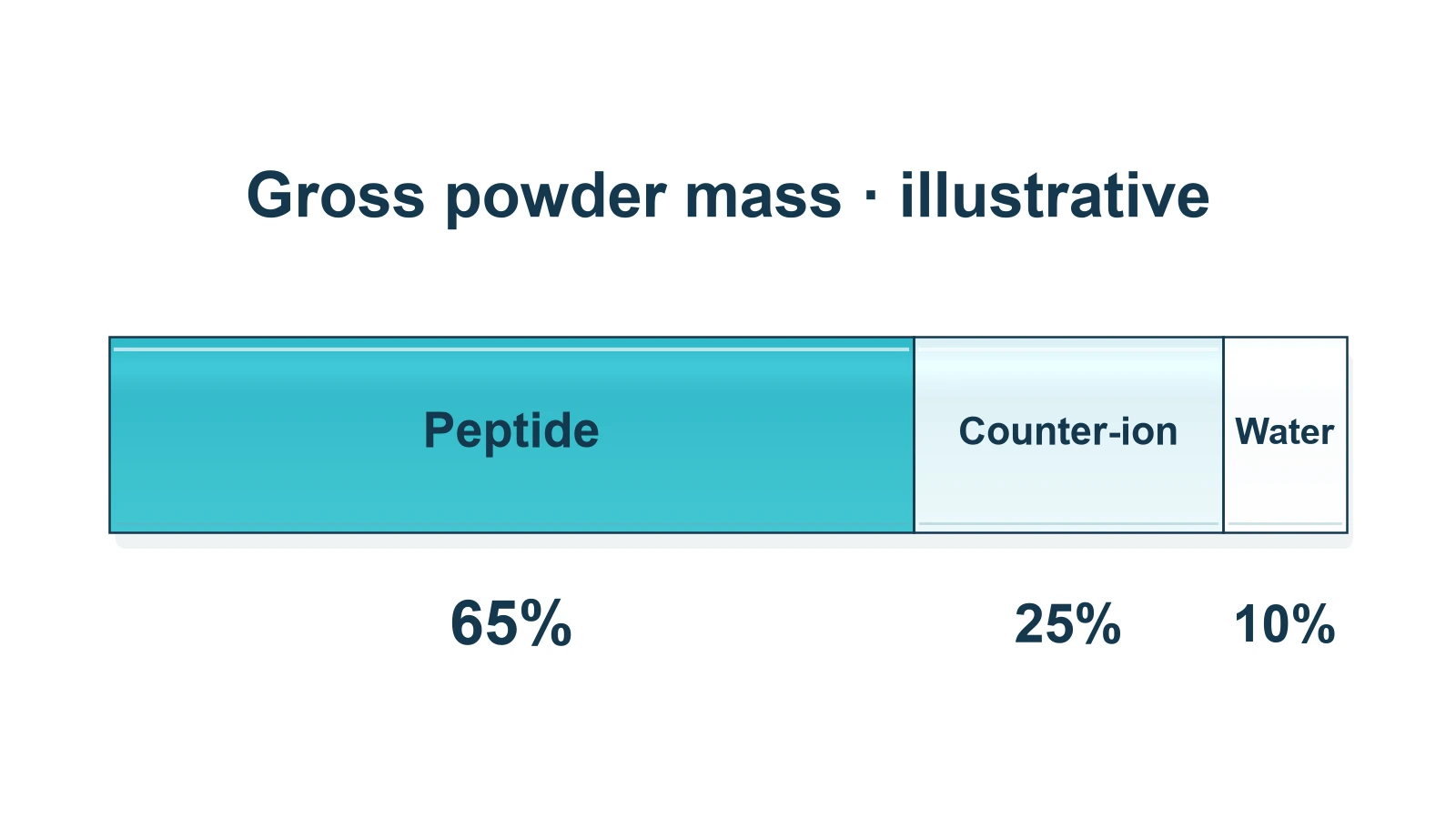
- Peptide65% · illustrative
- Counter-ion25% · illustrative
- Water10% · illustrative
Dilution: C1V1 = C2V2
Concentration × volume is the amount, and a dilution moves an amount without changing it, so C1 × V1 = C2 × V2.
C1 is the stock concentration and V1 the volume transferred from it. C2 and V2 are the concentration and final volume of the working solution. Enter any three and the calculator solves the fourth; the diluent is V2 − V1.
To make 1.000 mL of a 100.0 µg/mL working solution from a 5.000 mg/mL stock, first express both concentrations in µg/mL: the stock is 5000 µg/mL. Then V1 = 100.0 × 1.000 ÷ 5000 = 0.02000 mL, so transfer 20.00 µL of stock and make it up with 980.0 µL of diluent.
Manufacturers’ own instructions follow the same equation. Thermo Scientific dilutes one of its peptide calibration mixtures by combining 20 µL of the mixture with 180 µL of buffer: 0.5 pmol/µL × 20 µL equals 0.05 pmol/µL × 200 µL, the 50 fmol/µL the instructions call for.
Dilution notation varies between fields. In the calculator and on this page, 1:10 means one volume brought to ten volumes in total, a dilution factor of 10. Some fields write the same dilution as 1:9, one part plus nine parts.
If the diluent is a buffer such as PBS, add it only once the peptide has fully dissolved, because salts hinder solubility (Hoofnagle et al., 2016). The solvent guide covers first solvents and buffers.
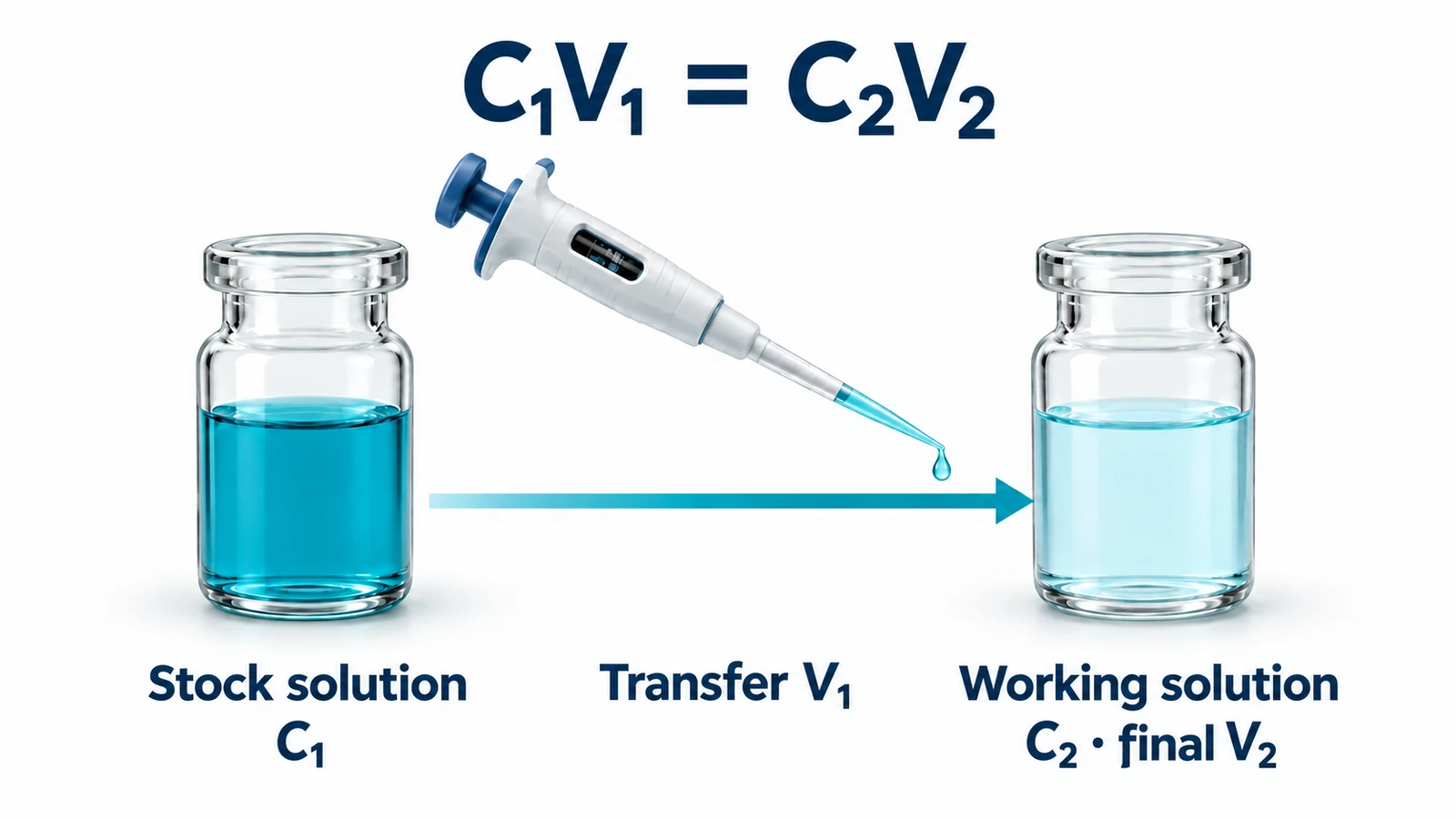
- Stock solutionC₁
- Pipette transferV₁
- Working solutionC₂ at final V₂
Serial dilution: the same factor at every step
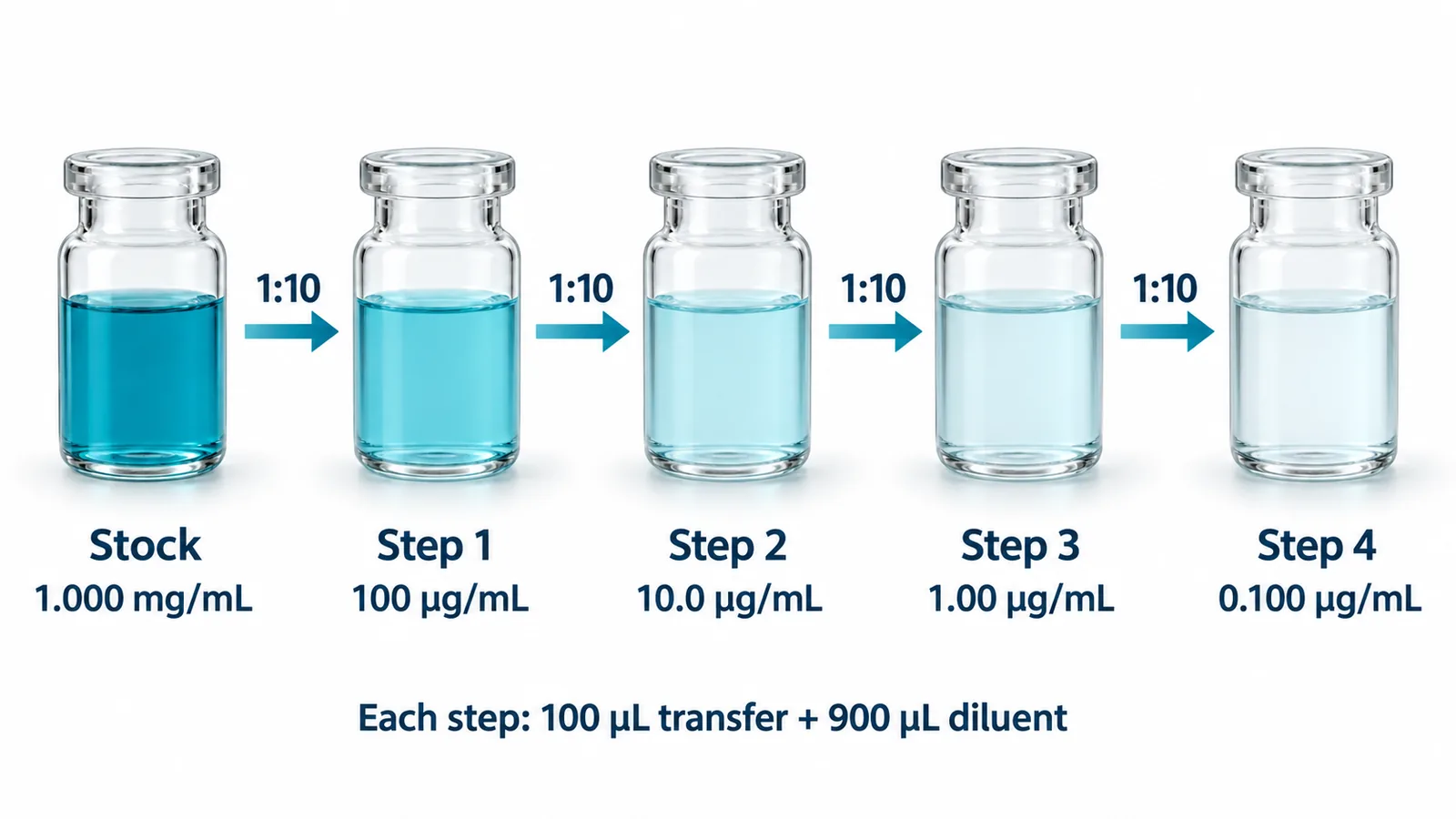
In a serial dilution each tube is diluted from the one before by the same factor F, so after n steps the concentration is C₀ ÷ Fⁿ.
Picture a row of dye. Move one part of a dye solution into nine parts of water, then one part of that into nine more. Each tube is a tenth as coloured as the one before, and the water in each tube brought no dye of its own: every bit of colour down the row came from the first tube.
Transfer errors compound down a series, so technique matters at every step:
- Use a fresh tip for every transfer. Hoofnagle and colleagues advise never re-using tips in a dilution series.
- Pre-rinse the tip several times with the solution before aspirating the volume to transfer.
- Dispense into the diluent itself, not onto the wall of the tube or vial.
For a final volume V in each tube, the transfer is V ÷ F and the diluent is V − V ÷ F. A 1:10 series in which each tube is made up to 1.000 mL transfers 100 µL into 900 µL of diluent at every step.
Four such steps from a 1.000 mg/mL stock give 100, 10.0, 1.00 and 0.100 µg/mL. Once the next transfer has been taken, tubes 1 to 3 hold 900 µL; only the last tube keeps its full 1.000 mL. The calculator lists the transfer, the diluent and the concentration for every step.
A series like this gives the concentration points of a calibration or dilution curve for an HPLC or LC-MS method.
How small a volume can be pipetted reliably?
The arithmetic is exact at any volume; a pipette is not.
According to METTLER TOLEDO Rainin, manual single-channel pipettes with variable settings from 2 µL to 20 mL are by far the most common in laboratories. A smaller transfer needs a specialist small-volume pipette, and even there the manufacturer’s specified error climbs steeply as the volume falls.
The calculator checks every transfer it computes against two thresholds:
- Below 2 µL is an error. The transfer falls outside the common pipette ranges, and the calculator suggests an intermediate dilution instead.
- From 2 µL up to 10 µL is a caution. The volume is within range but at its low end, where a 2–20 µL pipette’s specified systematic error runs from ±5.0% at 2 µL to ±1.2% at 10 µL.
A single step from a 5.000 mg/mL stock to 1.000 mL of a 1.000 µg/mL solution would need a 0.2000 µL transfer, in the range where specified systematic error runs from ±12% at 0.25 µL to ±48% at 0.1 µL. Two steps avoid it. 10.0 µL of stock into 990.0 µL of diluent gives 50.00 µg/mL, and 20.00 µL of that into 980.0 µL gives 1.000 µg/mL. Neither transfer is below the caution threshold.
Choose the smallest pipette whose range covers the volume. ISO 8655, as Rainin summarizes it, treats 10% of a variable pipette’s nominal volume as its useful minimum.
Technique counts as much as the instrument. Rainin’s list of common operator errors puts re-using a tip at up to 4%, leaving liquid on the tip instead of touching it off on the vessel wall at up to 3%, and skipping the pre-wet at up to 2%. Viscous or dense liquids, such as a DMSO stock solution, transfer more reliably with a positive-displacement pipette.
- 0.1 µL
- ±48% systematic, ±12% random (0.1–2.5 µL pipette)
- 0.25 µL
- ±12% systematic, ±6.0% random (0.1–2.5 µL pipette)
- 1 µL
- ±2.5% systematic, ±1.8% random (0.5–10 µL pipette)
- 2 µL
- ±5.0% systematic, ±1.5% random (2–20 µL pipette)
- 10 µL
- ±1.2% systematic, ±0.6% random (2–20 µL pipette)
- 1000 µL
- ±0.6% systematic, ±0.2% random (100–1000 µL pipette)
Error limits from the Eppendorf Research plus operating manual (§11.3), for variable single-channel models used with Eppendorf tips. The calculator’s two thresholds are set from these figures.
How much volume does the dissolved peptide add?
Roughly 7 µL for every 10 mg: enough to matter only in concentrated solutions.
Dissolved molecules occupy volume of their own. For proteins, the partial specific volume runs from 0.70 to 0.76 mL/g, and 0.73 mL/g is the usual average. Small proteins are denser than large ones, and extending a published density fit down to a peptide of about 1.4 kDa gives roughly 0.67 mL/g. That value lies below the measured data, so every displacement figure here is approximate.
At 0.73 mL/g, 10 mg of peptide adds about 7.3 µL; at 0.67 mL/g, about 6.7 µL. When a measured volume of solvent is added to powder in a vial, the final volume is the solvent plus that extra, and the true concentration is slightly lower than amount ÷ solvent volume.
The calculator shows the approximate displacement at 0.73 mL/g and flags it when it exceeds 1% of the solvent volume, which happens only above about 13.7 mg/mL.
No correction applies to a volumetric flask filled to its mark: its final volume is already exact, whatever the peptide occupies.
Will the solution fit the container?
The calculator checks each computed volume against the container you choose, and it treats vials and volumetric flasks differently.
Leave room above the liquid
A vial or microcentrifuge tube needs headspace. The calculator warns when the liquid would fill more than 90% of the stated capacity and reports an error above 100%. Presets cover a 1.5 mL tube, a 2 mL HPLC vial and 3, 5 and 10 mL vials, and any other capacity can be entered.
Filled to the mark by design
A volumetric flask is meant to be filled exactly to its mark, with headspace in the neck above it. The calculator passes a 10 mL volumetric flask at its nominal volume and reports an error only above it.
Change the container or the target
Peptide A, with a measured content of 10.00 mg and a molecular weight of 1,250.0 g/mol, needs 8.000 mL to reach 1.000 mM. That is more than a 3 mL vial holds, so the calculator reports a capacity error. Prepare the solution in a volumetric flask, whose volume then sets the concentration, or choose a higher stock concentration that fits the vial and dilute from it for the method.
A count of volumes, for freeze–thaw control
Aliquots exist so a stock solution is not frozen and thawed repeatedly. The aliquot mode divides a stock volume by an aliquot volume in µL and reports the count and the remainder, never an amount of peptide per aliquot. The count is a ceiling, because not every microlitre can be recovered from a container. The calculator accepts aliquots of 10 µL or more; one manufacturer’s own minimum for a peptide mixture is 20 µL. The storage guide covers aliquot size and tube choice.
How exact is a calculated concentration?
As exact as its inputs. The arithmetic is exact; the solution is only as good as the amount, the pipette and the container.
The calculator displays four significant figures and never rounds inside a calculation. That precision belongs to the arithmetic, not to the solution. Displacement alone can move a concentration by a few tenths of a percent, a small transfer can carry 1 to 5% systematic error, and two laboratories’ net-content measurements of the same peptides differed by up to 12.5%.
A calculated concentration is a planned value. Where a method needs the measured concentration, amino acid analysis is the reference method, and UV absorbance with a predefined coefficient can serve for well-characterized peptides (Hoofnagle et al., 2016).
Record what the number rests on: the basis of the amount, the molecular weight, the solvent, the volumes and the container. The calculator’s preparation record holds the basis, solvent, volume and concentrations, with the date and a blank for initials, ready to copy or print. Most of the exercises in the HPLC teaching guide start from one prepared solution.

- Blank label fieldsContents; concentration; final solvent; source lot; date; initials; re-test or discard date.
Worked laboratory examples
| # | Formula | Value |
|---|---|---|
| E1 | 10 mg ÷ 2 mL | 5.000 mg/mL · 5,000 µg/mL |
| E2 | 5 mg/mL; 1250 g/mol | 4,000 µM · 4.000 mM |
| E3 | Peptide A: 10 mg; 1 mM; 1250 g/mol | 8.000 mL · The liquid volume exceeds container capacity. |
| E4 | 10 mg × 80% × 98% | 7.840 mg |
| E5 | 5 mg/mL → 100 µg/mL; 1 mL | Transfer: 20.00 µL + Diluent: 980.0 µL |
| E6 | 1:10 × 4; 1 mL | Transfer: 100.0 µL + Diluent: 900.0 µL; 100.0 → 10.00 → 1.000 → 0.1000 µg/mL; After the next transfer, tubes 1–3 hold 900 µL. |
| E7 | 1.5 mL ÷ 50 µL | Aliquots: 30, remainder 0 µL |
| E8 | 5 mg/mL → 1 µg/mL; 1 mL | 0.2000 µL · Transfer below 2 µL. Prepare a 1:100 intermediate dilution. |
Common questions about laboratory solution calculations.
How is the concentration of a stock solution calculated after reconstitution?
Divide the amount of peptide by the final volume of solution. Milligrams divided by millilitres gives mg/mL; multiply by 1000 for µg/mL. Use an amount on a stated basis, such as a measured content, and the final volume, which in a vial is the solvent plus the small volume the dissolved peptide adds, about 7 µL for every 10 mg.
What volume of solvent gives a 1 mg/mL or a 1 mM stock solution?
Divide the amount by the target: V = m ÷ c for a mass concentration, or V = m ÷ (c × molecular weight) for a molar one. Peptide A, with a measured content of 10.00 mg and a molecular weight of 1,250.0 g/mol, needs 8.000 mL for 1.000 mM. Start from an amount you can defend, a measured content or gross mass × net content × purity, not the label figure. If the volume exceeds the container, prepare the solution in a volumetric flask, or make a more concentrated stock and dilute it for the method.
How do I convert mg/mL to µM?
Divide the mass concentration by the molecular weight in g/mol, then multiply by 1,000,000. It works because 1 mg/mL is 1 g/L, and grams per litre divided by grams per mole gives moles per litre. At 1,250.0 g/mol, 5.000 mg/mL is 4.000 mM, or 4,000 µM. A mass concentration needs no molecular weight at all; the molar forms do, and the weight must match the mass basis.
Which molecular weight should I enter: free peptide, salt or batch?
The one that matches the mass basis. Pair the free peptide’s sequence weight with a net peptide mass or a measured content, because net content already excludes counter-ions and water. A salt or batch weight belongs only with the gross powder mass, and only if it reflects the counter-ions and water actually present. Mixing the bases double-counts or drops the counter-ions: for a 1,200 g/mol peptide with two TFA counter-ions, the error is about 19%.
Should I correct for HPLC purity or for net peptide content?
Both, by multiplying. HPLC purity is the intended peptide’s share of the chromatogram’s peak area, read at about 214–220 nm, and it cannot see counter-ions or water. Net peptide content is the share of the weighed powder that is peptide at all, and it counts peptidic impurities too. Gross mass × net content × HPLC area purity estimates the intended peptide: 10.00 mg at 80.0% and 98.0% gives 7.840 mg.
Should I weigh a sub-milligram portion or dissolve the entire contents?
Sub-milligram weighing needs a microbalance. As METTLER TOLEDO summarizes USP 〈41〉, the smallest net weight a balance weighs reliably at 0.10% is about 820 scale divisions: 8.2 mg on a 0.01 mg balance, 82 mg on a 0.1 mg balance and, by the same rule, 0.82 mg on a 0.001 mg microbalance. A hygroscopic powder also gains water while it sits on the pan. Dissolving the entire contents avoids the weighing error, but it depends on recovering all of them and on a measured content for that container. Hoofnagle and colleagues suggest a solubility test on a small weighed portion first, and keeping dry powder in 0.1–1 mg portions.
How can concentration be measured when a sequence has no tryptophan or tyrosine?
Absorbance at 280 nm comes from tryptophan, tyrosine and cystine, so a sequence with neither tryptophan nor tyrosine absorbs little there, and predictions are less reliable without tryptophan. Sequence-based coefficients exist at 205 nm (Anthis and Clore, 2013) and at 214 nm (Kuipers and Gruppen, 2007), where the peptide bond itself absorbs. Measure against a blank of the same solvent. Amino acid analysis remains the reference method.