
A field guide for research buyers
How to read a peptide certificate of analysis.
A certificate of analysis, usually shortened to COA, is a laboratory report on one sample from one batch. This guide shows you what the common terms mean, what the numbers can tell you, and what they cannot.
For laboratory research use only. Not for human or veterinary use.
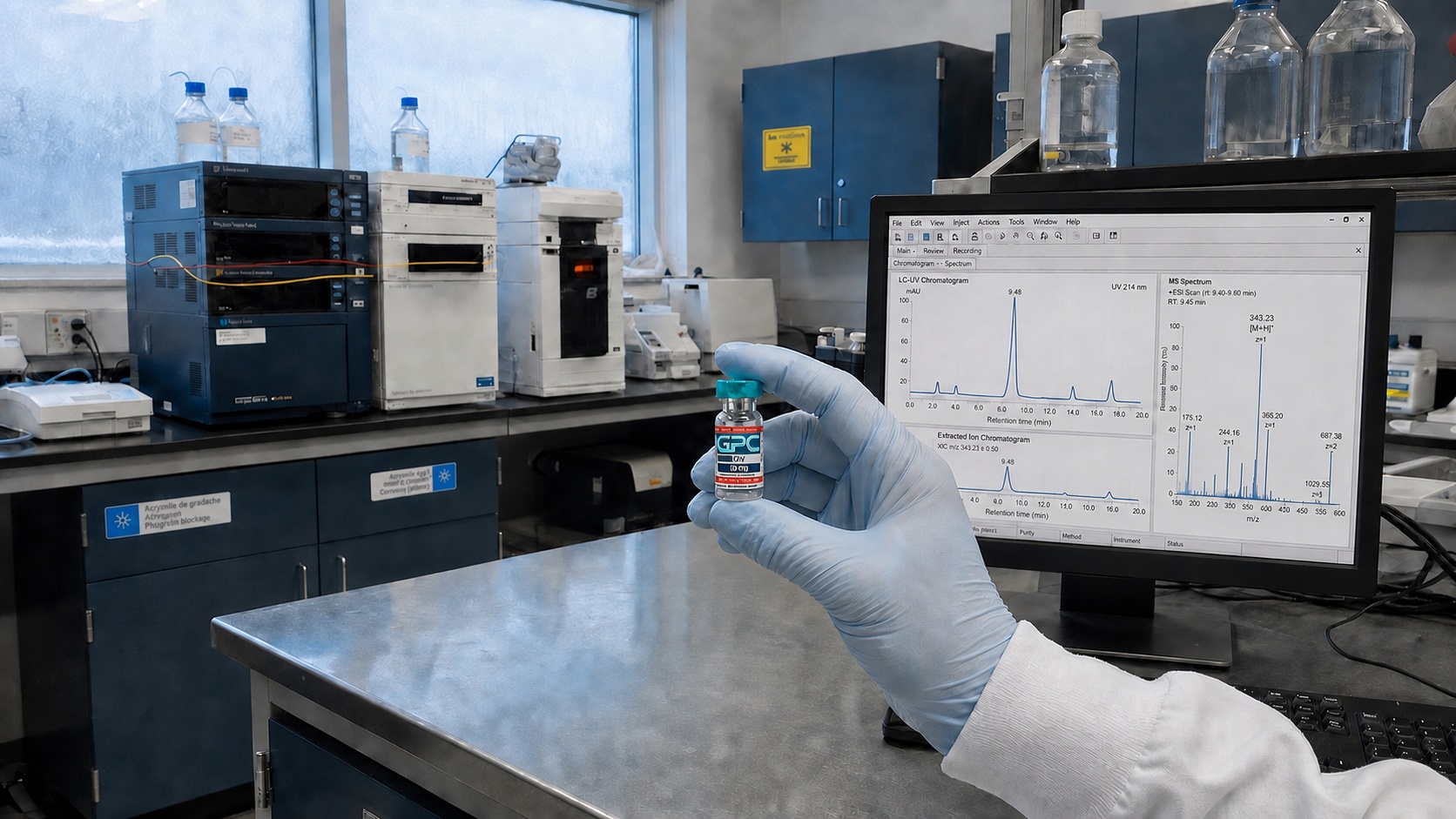
What is a peptide certificate of analysis?
It is a snapshot of what a laboratory measured in one sample from one production batch.
A batch is a group of material made together under the same production run. The COA provides evidence about that batch, but it is not a direct test of every vial filled from it. It also does not, by itself, establish safety or suitability for any particular use.
Start with three simple checks:
- Match the lot number. “Lot” and “batch” usually mean the same thing here. The number on the report should exactly match the number printed on the vial.
- Identify the laboratory. The report should name who performed the testing and provide a report number or another way to verify it.
- Look for the test method and supporting data. A number is easier to trust when the report explains how it was measured and includes the graph or instrument output behind it.
Keep those three checks in mind as you read. The rest of this guide explains the common fields one at a time and shows how to separate useful evidence from an unsupported claim.
What do common peptide COA fields mean?
Laboratories do not all use the same report design or wording. Use this as a general reference, not as a template that every COA must follow. A “panel” simply means a group of related tests ordered together.
- Testing laboratory
- The lab the manufacturer used for this batch, named.
- Identity and batch
- Which compound, and which production run it came from.
- Purity, and how it was measured
- The reported value, and the method that produced it.
- Chromatogram
- The separation trace behind the number. A purity figure quoted without one is a claim, not a result.
- Mass confirmation and date
- Confirms the molecule is the one the identity row names.
Connect the report to the sample
- Laboratory and report number: the name of the laboratory that issued the result and the unique reference used to look up or verify the report.
- Compound and sample ID: the name of the material submitted for testing and the tracking code the laboratory assigned to that sample.
- Lot or batch number: the production group represented by the tested sample. This number should match the vial you are evaluating.
- Analysis date and authorization: when the testing was performed or reported and, where shown, who reviewed and approved the result.
Read every result with its method
- Method: the test used to produce the result. It may name the instrument, sample preparation, settings, or reference material used for comparison.
- Identity or mass confirmation: evidence that the material detected has the expected molecular mass or other identifying features of the named peptide.
- Purity and chromatogram: the proportion of the detected signal assigned to the main peptide peak, together with the graph that shows the separated peaks.
- Net content or assay: an estimate of how much peptide is present. The total weight of dried powder can also include water, salts, counterions, or other formulation material.
Units and qualifiers change the meaning
- Specification or acceptance criterion: the limit chosen for comparison. The measured result is checked against this limit to decide whether it passes that particular test.
- LOD and LOQ: LOD is the smallest amount the method can detect. LOQ is the smallest amount it can measure with suitable accuracy and precision. “Below LOQ” means too little to measure reliably, not necessarily zero.
- NMT and NLT: short for “not more than” and “not less than.” NMT 1.0%, for example, means the result must be 1.0% or lower.
- Pass, fail or conforming: the laboratory’s conclusion after comparing one result with its stated limit. A pass for one test does not automatically mean every other test was performed or passed.
Some fields appear only when ordered
- Bacterial endotoxins: a test for endotoxin material associated with Gram-negative bacteria. Read the method, units, result, and comparison limit together.
- Elemental impurities or heavy metals: measurements for individual elements such as lead, cadmium, arsenic, or mercury. Look for the element name, result, units, method, and measurement limit.
- Water, residual solvents or counterion: measurements of non-peptide material that may contribute to the dried powder’s total mass.
- If a panel is missing, do not read the blank space as a zero. The laboratory may simply not have been asked to run that test.
What does an HPLC purity figure actually mean?
HPLC stands for high-performance liquid chromatography. The instrument pushes the dissolved sample through a column that separates compounds because they travel through it at different speeds. A detector records the separated material as peaks on a graph called a chromatogram. The main peptide should produce the main peak. Smaller peaks can represent peptide-related impurities or other compounds the detector can see.
A result such as 99% HPLC purity usually means the main peak produced about 99% of the total integrated detector signal under that specific method. It does not mean that 99% of the powder in the vial is peptide. Water, salts, counterions, and anything the detector does not respond to may not appear in that percentage. Read the number with the chromatogram, detector settings, and integration method. “Integration” is the software’s calculation of the area under each peak.
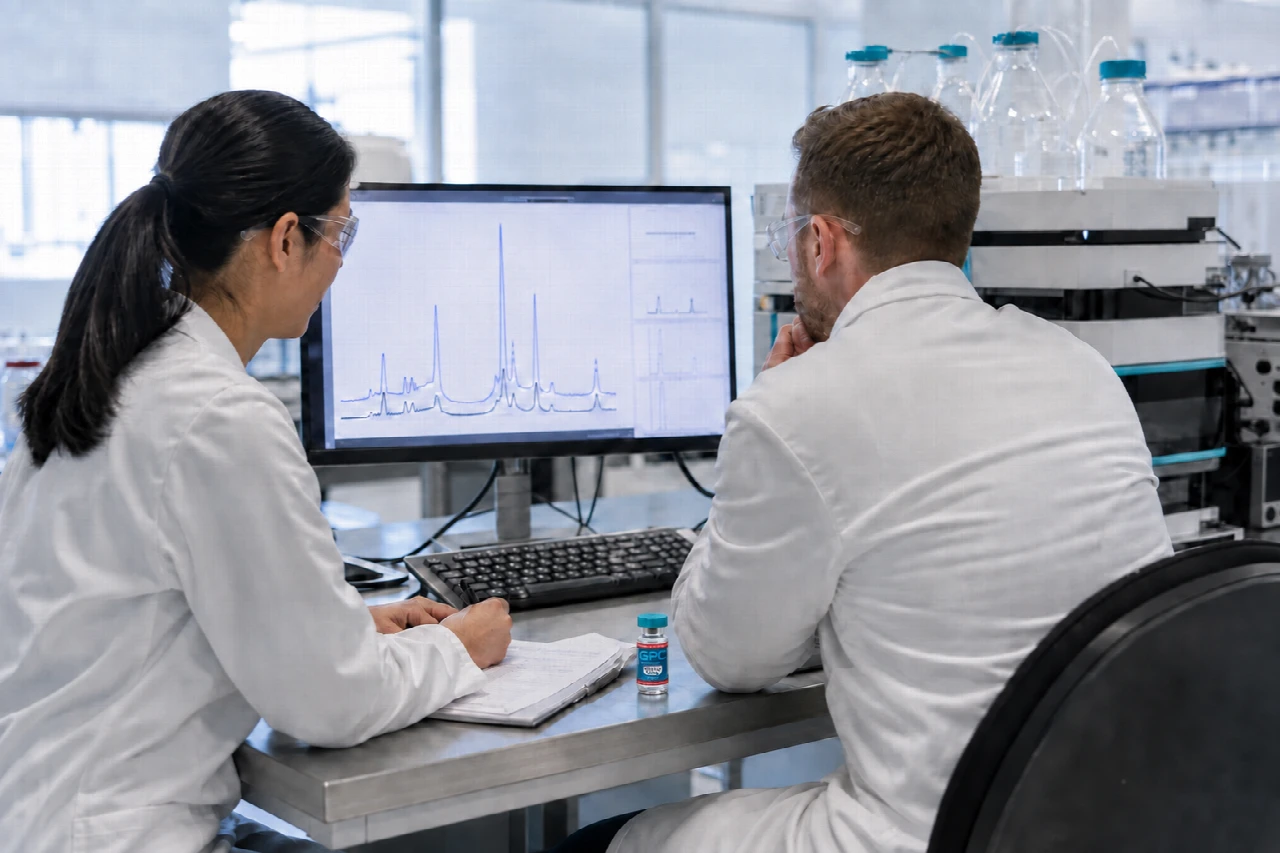
What do identity and net-content results show?
A COA is usually answering three different questions: What is it? How much of the detected signal is the main peptide? How much peptide was measured? One result cannot answer all three.
Does the measured mass match?
LC-MS means liquid chromatography combined with mass spectrometry. After separating the sample, the mass spectrometer measures charged versions of its molecules. Software converts those signals into an estimated molecular mass and compares it with the mass expected for the peptide. A close match supports identity, but mass alone may not distinguish two compounds with the same mass or prove the exact amino-acid sequence. A laboratory may need a second, different kind of test for stronger confirmation.
How many milligrams of peptide were measured?
An assay is a measurement of amount, often made by comparing the sample with a reference material of known concentration. This is different from weighing all the dry powder. The powder can contain peptide plus water, counterions, residual salts, or formulation ingredients. The report should explain the basis used for the result, such as measured “as is,” corrected for water, or corrected for counterion content.
Three questions need three answers
Identity asks what compound was detected. HPLC purity compares the main peak with other detected peaks. Net content asks how much peptide was measured. A high purity number does not prove identity or amount, and a correct mass does not prove purity or amount.
What does a bacterial-endotoxin result show?
Endotoxins are pieces of the outer membrane of Gram-negative bacteria. They can remain after bacteria are no longer alive. A bacterial endotoxins test, or BET, looks specifically for this material. It is not the same as a sterility test, which looks for living microorganisms, and it does not detect every substance that could cause a fever response.
How was the signal produced?
BET methods can produce a visible gel clot or measure a colour or cloudiness change with an instrument. Some methods use recombinant, meaning laboratory-produced, test reagents. The COA should name the procedure instead of saying only “endotoxin tested,” because different procedures produce and interpret signals differently.
Could the sample interfere with the test?
The “sample matrix” means everything present in the prepared sample, including the peptide, water, buffer, salts, and other ingredients. Those materials can weaken or strengthen the test reaction. Laboratories check for interference by adding a known amount of endotoxin and confirming that the method can recover it. This is often called spike recovery or an inhibition and enhancement check.
Read the number and its units together
EU means endotoxin units, a standardized measure of endotoxin activity. A result may be reported per millilitre, per milligram, or per vial, so compare it only with a limit written on the same basis. A low endotoxin result does not prove sterility, absence of other pyrogens, or suitability for human or veterinary use.
How do you read a heavy-metals panel?
“Heavy metals” is a familiar but imprecise label. Modern reports often say “elemental impurities” and list each element separately, commonly lead, cadmium, arsenic, and mercury. A broader panel may include metals used as manufacturing catalysts or other elements selected because the production process could introduce them. If the report does not list an element, do not assume it was tested.
Laboratories often use ICP-MS, which means inductively coupled plasma mass spectrometry, or ICP-OES, which means inductively coupled plasma optical emission spectroscopy. In simple terms, the sample is usually dissolved or digested, turned into a very hot plasma, and measured element by element. Read the result with its units and LOQ. “Below LOQ” means the amount was too low for that method to measure reliably, not that the element was completely absent. ICH Q3D limits are designed for drug products and depend on route and daily exposure, so they are not automatic pass or fail limits for a research vial.
How do you check whether a COA is real?
A polished logo or official-looking PDF is easy to copy. Verification depends on details you can check. Ask these three questions of any COA, including one published by GPC.
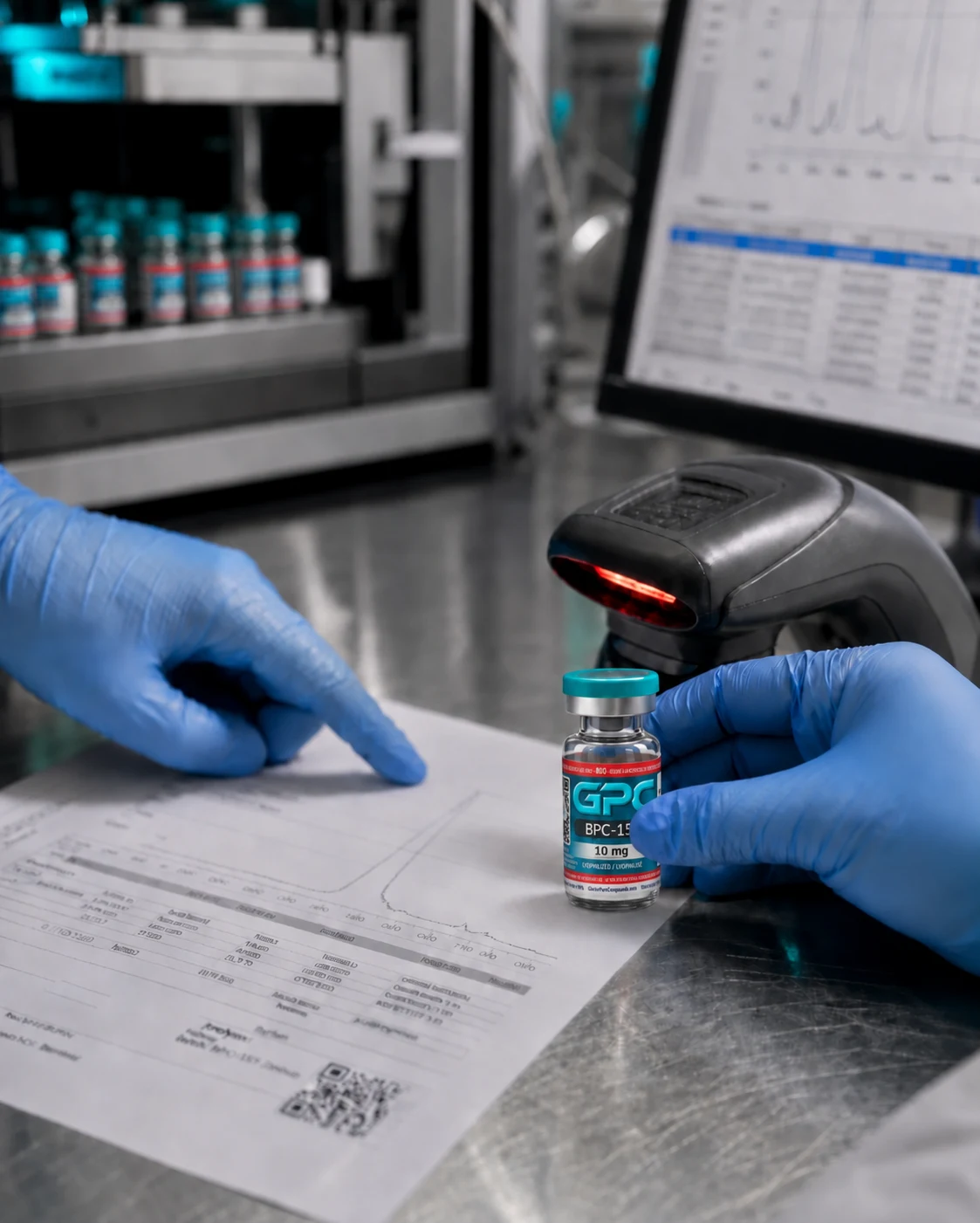
Match the lot to the vial
Find the lot or batch number on both the report and the vial. If the numbers do not match, the report describes a different production group.
Confirm it with the laboratory
Look for the laboratory name and report number. Use the laboratory’s public verification tool when available, or contact the laboratory through contact information you found independently. A screenshot with a logo is not enough.
Check the date and current inventory
A real COA can still be reused incorrectly. Confirm that the report belongs to the current lot, not an older production run that is no longer being shipped.
What can a COA not tell you?
A COA is useful evidence, but it has a boundary. The easiest way to remember that boundary is to ask which sample was actually placed in the instrument.
What one sample from the batch measured
The result is direct evidence about the sample the laboratory received. When the lot number matches, it is also useful evidence about the production batch that sample represents.
The exact condition of every vial
The laboratory did not test every vial. A batch result cannot rule out vial-to-vial variation or changes caused later by storage, shipping, time, or handling. Testing a vial from your own order adds evidence about the material you actually received.
A report with no traceable lot
If the COA cannot be connected to a lot number printed on the vial, there is no visible link between the tested sample and the material in front of you. Set that report aside.
What does GPC publish for each lot?
The product lot page provides testing data from GPC’s supply-chain verification process. It presents the reported analytical values and methods in a consistent table, including separate component results for blends when available.
GPC transcribes these supply-chain testing results as part of its inventory selection and validation processes. Some lots may also have testing commissioned by GPC, and those results are identified on the lot page when available.
Product quality and analytical testing involve many variables. GPC therefore recommends that customers arrange their own independent laboratory analysis to reduce uncertainty and obtain evidence that best represents the research peptide inventory they received at that point in time.
Handling, storage conditions, temperature, time, and other variables can affect product quality and may cause a later result to differ from the initial supply-chain testing. These results describe a sample from the production lot, not a direct test of the exact vial delivered in your order. With written pre-approval, the GPC Verification Program credits one tested vial from an eligible 10-vial research kit and approved laboratory fees for identity, net content, and purity testing.
Common questions about peptide COAs.
What is a peptide certificate of analysis?
It is a laboratory report on one sample from one production batch. It may include identity, HPLC purity, net content, and any additional test panels that were ordered. It is useful evidence about that sample and batch at the time of testing, but it is not a direct test of every vial.
What purity figure should a research peptide COA report?
Do not judge the report by one percentage alone. Check that the result belongs to the lot being sold, comes from a named laboratory, states the method, and includes the chromatogram behind the HPLC result. GPC applies a 99.00% inventory acceptance standard to the purity reported for a lot. That is an inventory rule, not a guarantee that every vial has been individually tested or will produce the same result.
Can a COA be faked or reused?
Yes. A report can be copied, edited, or attached to a newer lot that it did not test. Check the laboratory, report number, lot number, and date. Confirm the report through the laboratory when possible. If the evidence still cannot be verified, commission an independent test of your own sample.
Does GPC publish COAs for its products?
GPC publishes the available independent laboratory results tied to every lot offered for sale, with the issuing laboratory named. The analytical values are transcribed, and matching public COAs are linked as GPC supply-chain test results through COA Coalition. The catalog lot number uses the source’s BATCH / SEARCH CODE so it matches the verification link. Some lots may also have GPC-commissioned testing. Customers can add another layer of evidence through the GPC Verification Program, which credits eligible vial and approved testing costs after written pre-approval. The Certificate of Analysis Policy explains the full approach.