
A reference guide for stability and degradation research
Peptide stability and degradation in the laboratory.
Peptides change over time. Water, heat, oxygen, light and pH push a sequence toward predictable chemical changes, and a laboratory can measure each one. This guide covers the main degradation pathways, how storage slows them, and how to plan a small stability study with the instruments most analytical laboratories already have.
For laboratory research use only. Not for human or veterinary use.
In this guide
What does peptide stability mean?
Stability is how well a peptide keeps its chemical identity and amount under stated conditions, over a stated time.
The conditions and the time are part of the answer. The same peptide can remain essentially unchanged for a long period as a sealed, frozen powder and change measurably within days in solution at room temperature. Stability is not a single property of a compound, and a statement about it means little without the conditions behind it.
Two kinds of change matter:
- Chemical change: covalent bonds break or form, creating new molecules with different masses or structures.
- Physical change: the molecule stays intact but aggregates, sticks to surfaces or comes out of solution, so less of it is available to measure.
Both show up in the laboratory as a smaller main peak, new peaks or a lower recovered amount. Telling them apart is most of the work.
What are the main peptide degradation pathways?
Most chemical degradation follows a small number of routes, and the sequence tells you which to expect. Find a compound’s sequence in the GPC compound library and check it against the residues named below.
The backbone is cut
- What happens: water breaks a peptide bond and the chain splits into two fragments.
- Where to look: bonds after aspartic acid, especially aspartate–proline and aspartate–glycine, are the most vulnerable, and acidic conditions speed the reaction.
- What you see: new peaks, often eluting earlier, whose masses add up to the parent mass plus one water.
Asparagine becomes aspartate
- What happens: asparagine loses its side-chain amide through a ring intermediate, leaving aspartate or isoaspartate. Aspartate can isomerize through the same ring.
- Where to look: asparagine followed by glycine or serine reacts fastest, and the reaction speeds up at neutral to basic pH and higher temperature. Glutamine reacts far more slowly.
- What you see: a mass increase of about 1 Da for deamidation, and no mass change at all for isomerization, which only the chromatography can separate.
Oxygen is added to side chains
- What happens: methionine becomes methionine sulfoxide; tryptophan, cysteine, histidine and tyrosine can oxidize too.
- Where to look: any sequence containing those residues, especially in solution with dissolved oxygen, trace metal ions, peroxides or light.
- What you see: a mass increase of 16 Da per oxygen, often as a peak eluting just before the parent.
The ends of the chain rearrange
- What happens: an N-terminal glutamine or glutamate can close into pyroglutamate, and the first two residues can split off together as a ring called a diketopiperazine.
- Where to look: glutamine or glutamate at the N-terminus, and proline or glycine as the second residue.
- What you see: a loss of 17 Da from glutamine or 18 Da from glutamate, or a shortened chain missing its first two residues.
Molecules find each other
- What happens: free cysteines can pair into disulfide-linked dimers, existing disulfides can rearrange, and hydrophobic sequences can aggregate.
- Where to look: cysteine-containing sequences at neutral to basic pH, and concentrated solutions that are agitated or repeatedly frozen and thawed.
- What you see: a dimer at close to twice the parent mass, broad or late-eluting peaks, cloudiness, or simply less peptide recovered.
Which mass shifts point to which pathway?
LC-MS turns a new peak into a hypothesis. These shifts, measured against the parent peptide’s mass, are the ones seen most often.
- +16 Da
- One oxygen added: methionine sulfoxide, or oxidation of tryptophan, histidine or cysteine
- +32 Da
- Two oxygens added, such as methionine sulfone or a double oxidation
- +1 Da
- Deamidation of asparagine or glutamine (+0.98 Da)
- −17 Da
- Pyroglutamate from an N-terminal glutamine, with loss of ammonia
- −18 Da
- Loss of water: a succinimide intermediate, or pyroglutamate from an N-terminal glutamate
- 0 Da
- Isomerization or racemization: same mass, different retention time
- Two fragments
- Hydrolysis: fragment masses that add up to the parent plus 18 Da
- Near 2 × parent
- A disulfide-linked dimer: twice the parent mass, less 2 Da
A mass shift suggests a pathway; it does not prove one. Where the conclusion matters, confirm it with fragmentation data, retention behaviour or a reference material.
What makes a peptide degrade faster?
Water, temperature and the chemistry of a solution do most of the work. Storage is the practice of limiting all three.
Dry and cold is the slow lane
Freeze-drying removes the water that hydrolysis and deamidation need, which is why a sealed lyophilized peptide changes far more slowly than a solution. Moisture is the main threat to a dry powder: many peptide powders are hygroscopic and take up water from humid air whenever a vial is opened.
Water, pH and oxygen go to work
Once a peptide is dissolved, every pathway above can proceed. Many peptides are most stable in slightly acidic solution, roughly pH 5 to 6, and degrade faster above pH 8. Dissolved oxygen, trace metals and light drive oxidation, and microbial growth in solutions kept for long periods is another route to loss.
Every 10 °C matters
Chemical reaction rates commonly rise two- to threefold for each 10 °C increase. That rule of thumb is why a few days at room temperature can matter more to a solution than months in a freezer do to a sealed powder, and why temperature is the first variable most stability studies control.
How should lyophilized peptides be stored in the laboratory?
These practices are standard across peptide laboratories. They slow change rather than stop it, which is why a study measures instead of assuming.
- 01
Keep it sealed, cold and dark
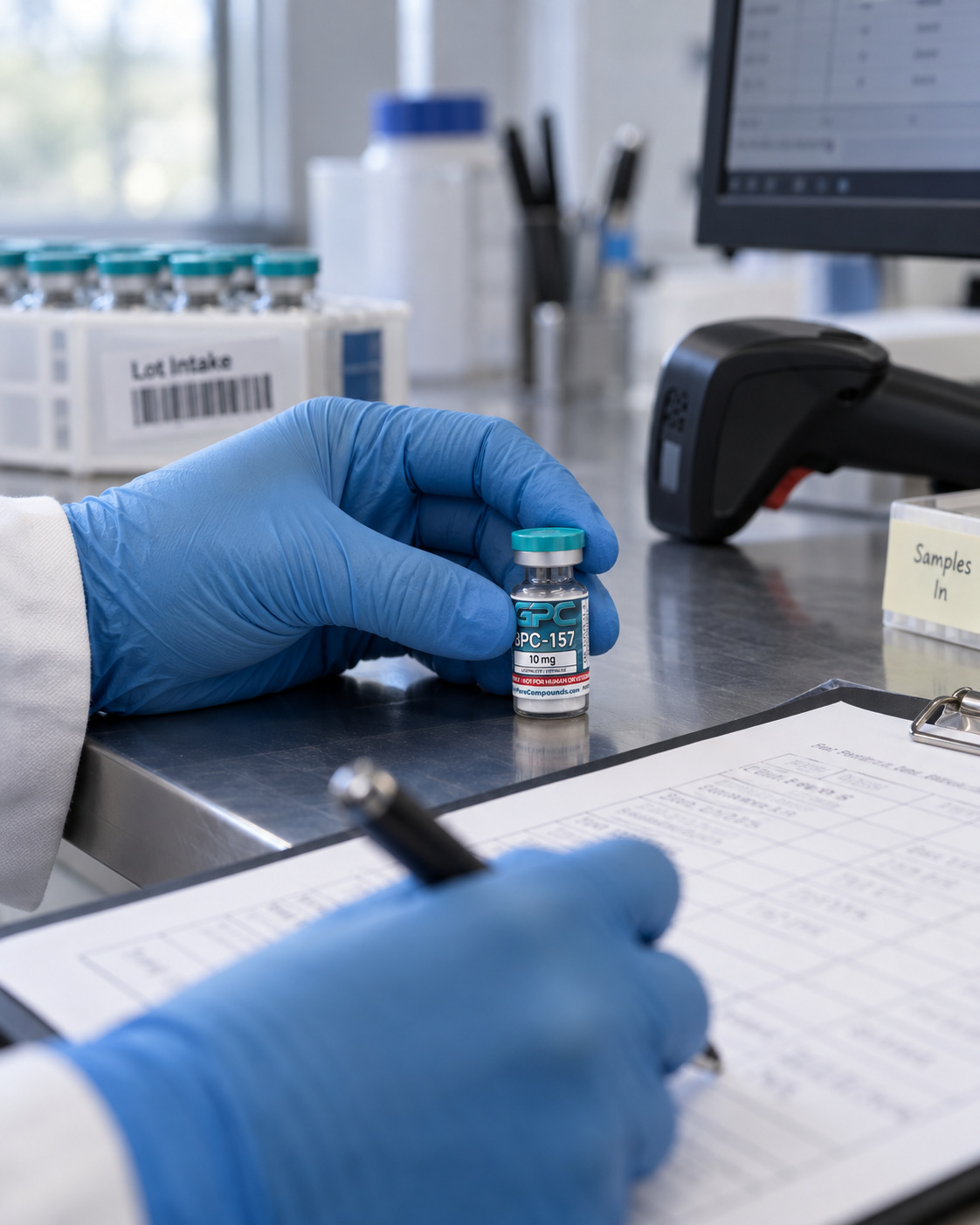
Store unopened vials at −20 °C or colder, away from light, and at −80 °C when material will be held for a long time. GPC holds its lyophilized stock at −20 °C or colder, shielded from light, in its Canadian warehouse.
- 02
Let it warm before you open it
Let a cold vial reach room temperature, ideally in a desiccator, before opening it. Opening a cold vial draws moist air onto the powder, and that water stays behind when the vial goes back into the freezer.
- 03
Prepare aliquots and limit freeze–thaw cycles
When a method needs repeated preparations, divide a solution into single-use aliquots in one session instead of returning to the same vial or tube. Each freeze–thaw cycle is another chance for aggregation, surface loss and moisture.
- 04
Log what happened
Record the lot number, the date received, the storage location, every opening and any temperature excursion. When a result looks wrong later, that log is what separates a changed sample from a method problem.
How do you design a small peptide stability study?
A useful study does not need a dedicated stability chamber. It needs a method that can see degradation, a plan written before the first sample is pulled, and controls that separate real change from noise.
- 01
Prove the method can see degradation
Deliberately stress small portions of the material first, with heat, acid, base, dilute hydrogen peroxide and light, and confirm that the HPLC method separates the resulting peaks from the main peak. This forced-degradation step is what makes a method stability-indicating; without it, a flat result may only mean the method cannot see the change.
- 02
Choose conditions and pull points
Pick conditions that answer your question, such as −20 °C, 4 °C, 25 °C and 40 °C, or a pH series in solution. Fix the pull points in advance, for example days 0, 1, 3, 7, 14 and 28 for solutions, with longer intervals for dry powder.
- 03
Build in controls and replicates
Keep a reference portion at −80 °C and analyze it alongside every pull, so instrument drift is not mistaken for degradation. Use at least duplicate samples per condition, and the same vial type, fill volume and headspace throughout.
- 04
Measure amount and identity together
Track the main peak area against the day-0 value, the area of each new peak and the mass of anything that grows. HPLC-UV quantifies the change; LC-MS tells you what the new peaks are.
- 05
Report the conditions with the result
State the lot number, salt form, concentration, solvent, container, storage conditions and method with every result. A stability finding applies to that material under those conditions. It does not establish an expiry date or suitability for any use outside the study.
ICH Q1A(R2) and Q1B describe stability and photostability testing for regulated drug substances. Their stress conditions are a useful starting point for research studies, even where their formal requirements do not apply.
What about shipping through a Canadian winter or summer?
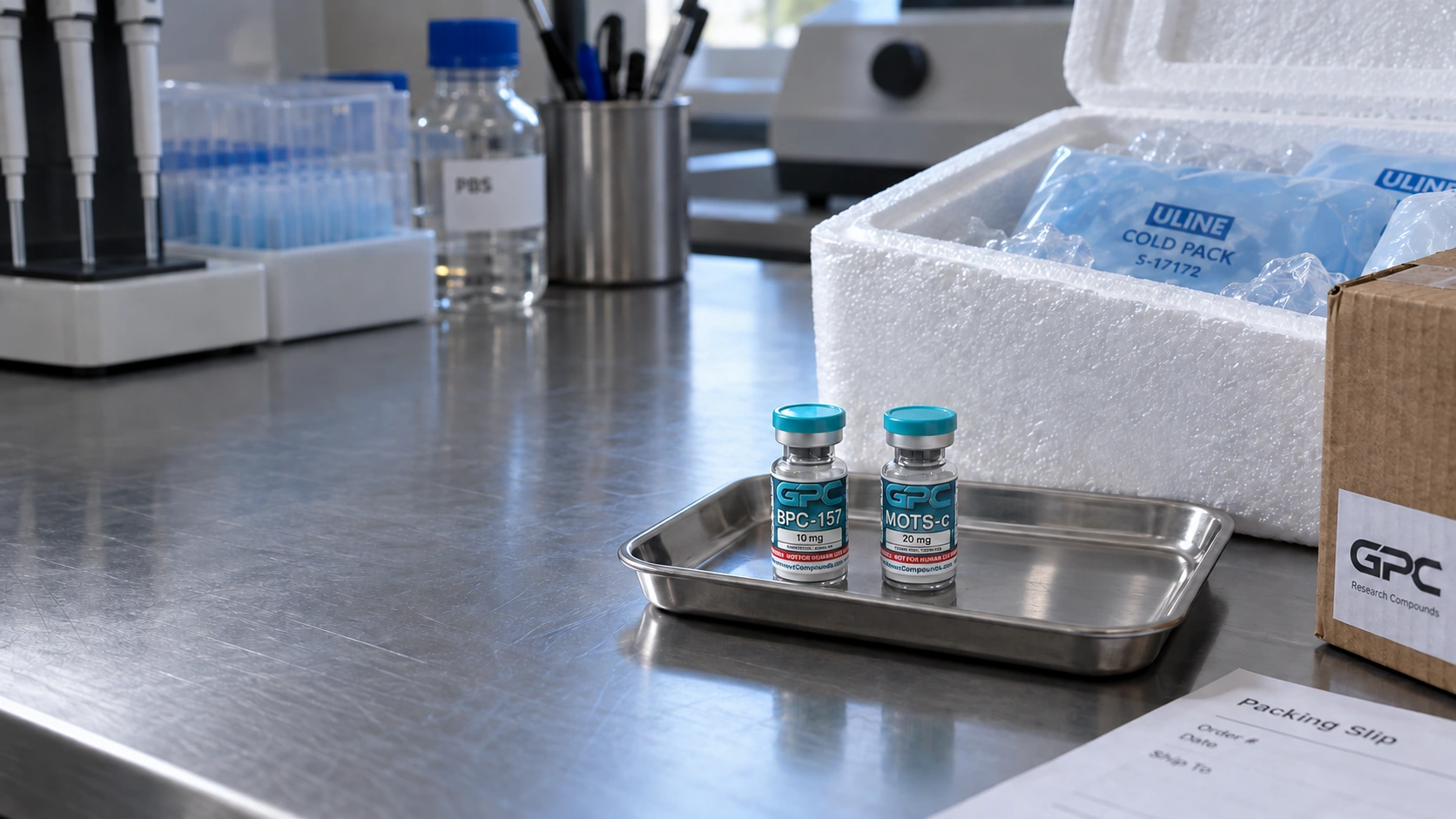
For a sealed, lyophilized peptide, cold in transit is generally not the concern; freezing a dry powder does not act on it the way freezing acts on a solution. Heat is the variable to watch. A parcel left in a delivery vehicle or on a sunny step in July can sit well above room temperature for hours.
Shipping inside Canada keeps transit short, and GPC parcels do not wait at a border. Plan deliveries for a time when someone can receive them, move vials to cold storage on arrival and note the condition of the package in your log. If a study depends on the history of the material, that log is part of the data.
If a parcel arrives warm or damaged, photograph it before you unpack it and report it under the Shipping Policy.
Common questions about peptide stability.
How long is a lyophilized peptide stable?
There is no single answer. It depends on the sequence, the salt form, residual moisture, the container and the storage temperature. Sealed lyophilized peptides are commonly stored for long periods at −20 °C or colder, but the only reliable figure for a particular material is one measured under your own conditions.
Why does a peptide degrade faster in solution than as a powder?
Hydrolysis, deamidation and most other pathways need water, and a dissolved peptide is also exposed to oxygen, pH and container surfaces. Freeze-drying removes most of that water, which slows those reactions greatly for as long as the powder stays dry.
Which amino acids make a peptide more prone to degradation?
Methionine, cysteine and tryptophan are prone to oxidation; asparagine, especially before glycine or serine, to deamidation; aspartic acid to cleavage and isomerization; and an N-terminal glutamine to cyclization. Their presence does not mean a peptide is unstable, only which changes to look for first.
Can a published lot result serve as a stability baseline?
A lot result describes a sample from that production batch at the time it was analyzed. It is a useful reference point, but it was not measured on your vial or with your method. A day-0 measurement of your own material, under your own method, is the baseline a study needs.
Does freezing and thawing damage peptides?
Repeated cycles can, particularly in solution: ice formation concentrates the peptide and any salts, which can promote aggregation, and each warm-up is another chance for moisture uptake. Single-use aliquots avoid the problem.